
Decorative items on a market stall with people walking in the background
The Taj Mahal with a reflection in a pool, surrounded by well-manicured gardens.
Traditional Nepalese temple with intricate architecture against a clear blue sky.
Decorative stupa with intricate designs against a natural background
Map showing a travel route from Delhi to Kathmandu
FREE CANCELLATION UP TO 30 DAYS BEFORE DEPARTURE. FULL TERMS APPLY.

13 Day Nepal & India Highlights Premium Tour | SherpaHolidays

Starting From
$2,950.00
Duration
13 Days
Best Season
Autumn
Max Altitude
2,500m (8,202ft)
Comfort Level
Easy
Dates & Prices


Full payment at booking secures your permits, private guides, and all logistics before your departure date.

Licensed Sherpa Guides
Permits & Logistics Included
Private Journeys Available
Altitude Safety Expertise

From the Taj Mahal to Everest. Thirteen days. One continent's full weight.

Some journeys cover distance, and some journeys cover ground. This is the second kind. Thirteen days connecting imperial India with Himalayan Nepal, moving from the sandstone walls of Delhi's Red Fort to the marble precision of the Taj Mahal, from the carved temples of Khajuraho to the burning ghats of Varanasi, and finally across the border into Kathmandu, where the medieval and the sacred exist side by side in a way that has not changed in centuries.

This is not a tour of postcard sights. Each place on this itinerary holds something specific: a story, a philosophical tradition, a piece of history that only makes sense when you are standing inside it. The Mughal emperors who built Agra Fort and the Taj Mahal. The Chandela kings of Khajuraho. The Buddha's first sermon at Sarnath. The Newari craftsmen whose work still fills the Durbar Squares of Kathmandu. Thirteen days is enough time to do all of it properly.

Our guides across both countries know these places the way people know the streets they grew up on. They will show you what is there and tell you what it means. That combination is rarer than it sounds.

13 Days Across Two Nations

Days 1 to 2  |  Imperial Delhi

Arrive in the capital and begin with the monuments that shaped modern India. The Red Fort, built by Shah Jahan in 1638, has two kilometers of sandstone walls enclosing a city within a city. Raj Ghat, the black marble platform where Mahatma Gandhi was cremated in 1948 and where the flame has burned continuously since. India Gate, Rashtrapati Bhavan, Qutab Minar, at 73 meters, the tallest brick minaret in the world. The Lotus Temple, a Bahai house of worship built in the shape of a flower, is open to all faiths and requires visitors to remain silent inside.

Days 3 to 4  |  The Pink City

Drive 260 kilometers southwest to Jaipur, the capital of Rajasthan, and one of the most architecturally coherent cities in India. The Amber Fort, a 16th-century hilltop palace reached by elephant. The Hawa Mahal, a five-story facade of 953 small windows designed so that royal women could observe street life without being seen. Jantar Mantar, an 18th-century astronomical observatory built entirely of stone, is still accurate to within two seconds.

Days 5 to 6  |  Mughal Splendor

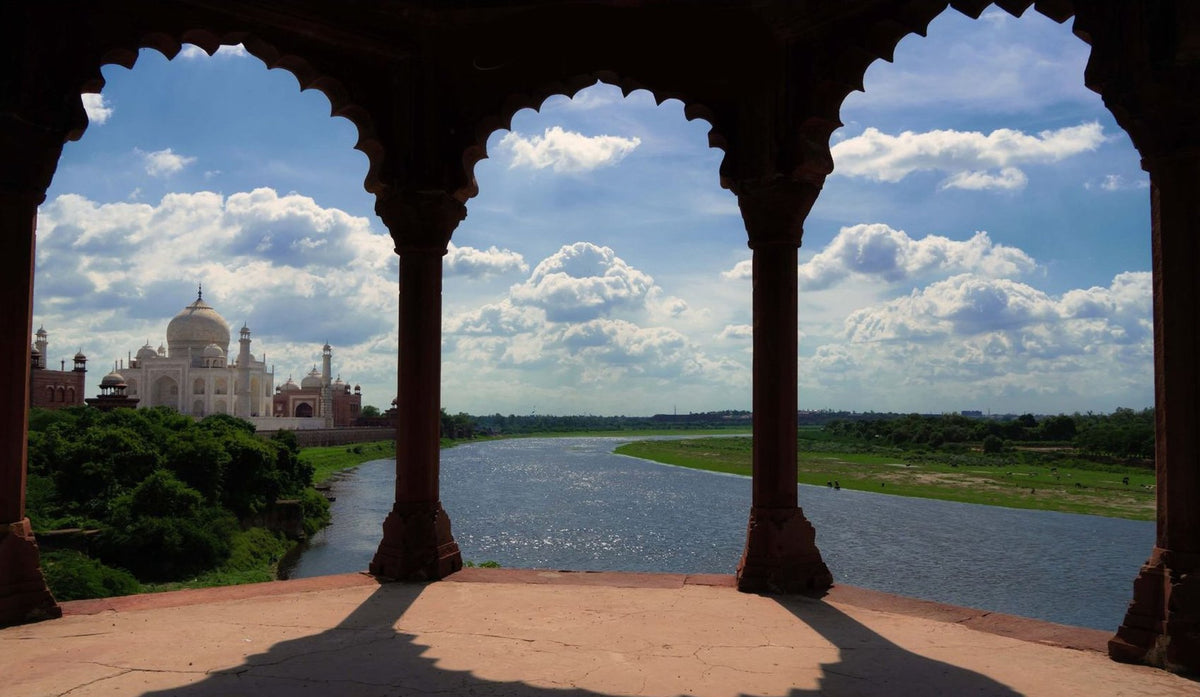
Drive to Agra with a stop at Fatehpur Sikri, a Mughal capital built by Emperor Akbar in the 1570s, abandoned within 15 years due to water shortages, and preserved ever since exactly as it was left. Then Agra and the Taj Mahal, which need no introduction but always exceed whatever introduction it receives. The Agra Fort, where Shah Jahan spent the final years of his life imprisoned by his own son, with a window view of the monument he built for his wife.

Days 7 to 8  |  Khajuraho and Varanasi

Drive to Khajuraho for the western and eastern temple groups, built by the Chandela dynasty between 950 and 1050 AD. The temples are known for their erotic sculpture, but the full program of carvings is far broader: celestial beings, warriors, animals, and scenes of daily life covering every surface. Evening light and sound show narrated by Amitabh Bachchan. Fly to Varanasi in the afternoon, the oldest continuously inhabited city in the world.

Day 9  |  The Holy Ganges

Sunrise on the Ganges by boat, moving along the ghats as the city wakes and the rituals of bathing, prayer, and cremation begin. The Kashi Vishwanath Temple, one of the twelve Jyotirlinga shrines of Shiva, was rebuilt in the 18th century with a gold-covered spire. Sarnath, seven kilometers from Varanasi, is where the Buddha delivered his first sermon after attaining enlightenment at Bodh Gaya.

Days 10 to 12  |  Kathmandu

Afternoon flight to Kathmandu and a traditional Nepalese welcome. Three full days in the valley: an early morning mountain flight with individual window seats and Everest visible on the horizon at 8,850 meters. Swayambhunath, Boudhanath, Pashupatinath, Patan Durbar Square, Bhaktapur, Hanuman Dhoka. A farewell dinner of Newari cuisine with a live cultural folk dance program.

Day 13  |  Departure

Final morning in Kathmandu before your private transfer to the airport and your international departure.

Day by Day

Day 1  Arrival in New Delhi  Mughal Foundations

Welcome at Indira Gandhi International Airport and transfer to your hotel. The afternoon is oriented toward two very different monuments. The Red Fort, built by the Mughal Emperor Shah Jahan in 1638 as the main residence of the imperial family, is a complex of palaces, halls, and gardens enclosed by 2.5 kilometers of red sandstone walls rising 33 meters above the city. Raj Ghat is quieter: a simple raised black marble platform in a park beside the Yamuna River, marking the site where Mahatma Gandhi was cremated on January 31, 1948. The eternal flame has burned here since that day. Both sites are within the old city. Both carry a weight that is difficult to describe and easy to feel.

Stay: Delhi Hotel

Day 2  New Delhi Sightseeing  The Garden City

The architecture of New Delhi, the planned capital built under British rule in the early 20th century, is on a different scale than the old city. India Gate is a 42-meter war memorial dedicated to the 82,000 soldiers of the British Indian Army who died in the First World War. Rashtrapati Bhavan, the Presidential Residence, is the largest head-of-state residence in the world by floor area, designed by Edwin Lutyens. Qutab Minar, the 73-meter minaret begun in 1193, is the tallest brick minaret ever built and a UNESCO World Heritage Site. The Lotus Temple, completed in 1986, is one of the most visited buildings on earth: a Bahai house of worship built in the form of a half-open lotus, open to visitors of any faith, requiring only silence inside.

Stay: Delhi Hotel

Day 3  Delhi to Jaipur  The Pink City

A 260-kilometer drive southwest through Rajasthan, arriving in Jaipur by mid-afternoon. The city was built in 1727 by Maharaja Sawai Jai Singh II and painted its distinctive terracotta pink in 1876 to welcome the Prince of Wales. The color has been maintained ever since by municipal regulation. Evening visit to the Birla Temple, a modern marble temple dedicated to Laxmi and Narayan, built by the Birla family in 1988. The white marble is illuminated at night against the Moti Dungri hill behind it.

Stay: Jaipur Hotel

Day 4  Jaipur  Forts and Observatories

The Amber Fort sits on a hill above the Maota Lake, 11 kilometers from Jaipur. Built in 1592 by Raja Man Singh I, it is a palace complex of red sandstone and white marble that took over a century to complete. The traditional approach is by elephant up the cobbled path to the main gate. Inside: the Hall of Public Audience, the Hall of Private Audience, the Sheesh Mahal whose mirrored ceiling reflects a single candle into a thousand points of light. Back in the city, the Hawa Mahal is a five-story pink sandstone facade built in 1799 as an extension of the royal palace, with 953 small windows designed to catch the breeze and allow royal women to observe the street below without being seen. The City Palace Museum holds the royal collection of weapons, textiles, and art. Jantar Mantar, built between 1728 and 1734, is an open-air astronomical observatory containing 19 large geometric instruments built entirely of stone and still precise to within two seconds. It is the largest and best-preserved of five such observatories built by Jai Singh II.

Stay: Jaipur Hotel

Day 5  Jaipur to Agra  The Ghost City

Drive 221 kilometers east to Agra with a stop at Fatehpur Sikri, one of the strangest places in India. Emperor Akbar built this city as his capital between 1571 and 1585, a planned Mughal city of palaces, courtyards, and mosques built from local red sandstone. He abandoned it around 1585, possibly due to water shortages, possibly for strategic reasons. The debate continues. What is certain is that the city has been largely uninhabited since and remains almost perfectly intact: the Buland Darwaza, the highest gateway in India at 54 meters; the Jama Masjid mosque; the Panch Mahal, a five-story pavilion built in graduated tiers. It stands in the sun exactly as it was left, which is why it is called a ghost city. Arrive in Agra in the afternoon.

Stay: Agra Hotel

Day 6  Agra  The Elegy in Marble

The Taj Mahal was built by the Mughal Emperor Shah Jahan between 1631 and 1653 as a mausoleum for his wife Mumtaz Mahal, who died giving birth to their 14th child. 20,000 workers and 1,000 elephants were employed in its construction. The white marble was brought from Makrana in Rajasthan. The inlay work uses 28 types of precious and semi-precious stones from across Asia. The building is identical on all four sides. It is the same from every angle. Photographs exist of it everywhere, and still, it is not possible to be fully prepared for the first time you see it in person. Afternoon visit to Agra Fort, a UNESCO World Heritage Site in its own right: a 16th-century Mughal fortification of red sandstone enclosing palaces, mosques, and audience halls. Shah Jahan was imprisoned here by his son Aurangzeb in 1658. He spent the last eight years of his life in the Musamman Burj tower, from which the Taj Mahal is visible across the river.

Stay: Agra Hotel

Day 7  Agra to Khajuraho  Light and Sound

A 400-kilometer drive southeast to Khajuraho, arriving in the late afternoon. The Chandela dynasty ruled this region from the 9th to 13th centuries and, during their peak, built between 84 and 85 temples over the course of roughly a century. 22 survive. They are known primarily for their erotic sculpture, but the program of carvings covers the full range of human experience: celestial nymphs, warriors, animals, loving couples, and scenes of court life. The sculpture is explicit in places and also deeply philosophical, representing the Hindu understanding of kama, one of the four aims of human life, as a path toward the divine rather than a distraction from it. Evening light and sound show at the Western Group of Temples, narrated by the actor Amitabh Bachchan, tracing the history of the Chandela kings and the creation of the temples.

Stay: Khajuraho Hotel

Day 8  Khajuraho to Varanasi  The Temple Trail

Morning exploration of the Western and Eastern Groups of Temples. The Kandariya Mahadeo Temple in the Western Group is the largest and most elaborate, rising 31 meters and covered on every surface with some of the finest medieval sculpture in India. The Eastern Group includes both Hindu and Jain temples and is quieter and less visited than the Western Group. Afternoon flight to Varanasi. Varanasi is the oldest continuously inhabited city in the world, a city that has existed as a place of pilgrimage on the west bank of the Ganges for at least 3,000 years. Mark Twain described it as older than history, older than tradition, older even than legend. He was not exaggerating. Evening by the river to watch the Ganga Aarti, the nightly fire ceremony at the main ghat.

Stay: Varanasi Hotel

Day 9  Varanasi  The Holy Ganges

The boat goes out before sunrise. The Ganges at dawn in Varanasi is one of the most significant sights in the world: pilgrims bathing in the river, priests performing puja on the stone steps, funeral pyres burning at the Manikarnika Ghat, where Hindus believe cremation grants direct liberation from the cycle of rebirth. The ghats stretch for six kilometers along the west bank, and each has its own character. The river moves slowly, and the city wakes slowly around you. After breakfast, the Kashi Vishwanath Temple, one of the twelve Jyotirlinga shrines, was rebuilt in the 18th century by the Maratha queen Ahilyabai Holkar, with its two towers plated in gold donated by the Sikh Maharaja Ranjit Singh. Afternoon drive to Sarnath, seven kilometers from Varanasi. This is the Deer Park where the Buddha, having attained enlightenment at Bodh Gaya, gave his first teaching to five companions in 528 BC. That teaching, setting in motion the Wheel of Dharma, is the foundation of Buddhism. The Dhamekh Stupa marks the spot. The Archaeological Museum holds the Lion Capital of Ashoka, the national emblem of India.

Stay: Varanasi Hotel

Day 10  Varanasi to Kathmandu  The Himalayan Leap

Afternoon flight from Varanasi to Kathmandu. The shift from the Gangetic plains to the Himalayan valley is as dramatic as any transition on this itinerary. Varanasi sits at roughly 80 meters above sea level. Kathmandu sits at 1,300 meters and is ringed by peaks. A traditional Nepalese welcome at the hotel. Take the evening to adjust, rest, and prepare for the three days ahead.

Stay: Kathmandu Hotel

Day 11  Kathmandu  Medieval Valleys

The Kathmandu Valley contains more UNESCO World Heritage Sites per square kilometer than almost anywhere else on earth. Today covers three of them. Swayambhunath, the Monkey Temple, sits on a hilltop above the city with a white stupa topped by a golden spire, the painted eyes of the Buddha watching over the valley in all four cardinal directions. It has been a place of Buddhist pilgrimage since at least the 5th century. Patan Durbar Square, 6 kilometers south of Kathmandu, is the historic heart of Lalitpur and contains the most concentrated collection of ancient Newari architecture in Nepal: bronze statues, stone temples, and the old royal palace built over many centuries by Malla kings. Hanuman Dhoka, the original royal palace of Kathmandu, stands at the center of the old city, surrounded by the buildings that grew up around it over 400 years of royal occupation.

Stay: Kathmandu Hotel

Day 12  Kathmandu  Everest and Ancient Cities

Early morning mountain flight from Tribhuvan International Airport. The one-hour flight follows the Himalayan range eastward, with every passenger given a window seat and a clear view of the peaks. Mt. Everest at 8,850 meters is visible on a clear morning along with Lhotse, Makalu, Cho Oyu, and the full sweep of the eastern Himalaya. The pilots angle the aircraft so both sides of the cabin see the mountains equally. It is, by any measure, an extraordinary hour. After breakfast: Boudhanath, the great white stupa that is the center of the Tibetan Buddhist community in Nepal and one of the largest stupas in the world. Pashupatinath Temple, the most sacred Hindu site in Nepal, is on the banks of the Bagmati River. Bhaktapur, the third of the medieval cities in the valley and the best preserved, has its Durbar Square largely rebuilt after the 2015 earthquake, but still houses the 55-Window Palace and the five-tiered Nyatapola Pagoda. Evening farewell dinner of traditional Newari cuisine with a live cultural folk dance program.

Stay: Kathmandu Hotel

Day 13  Departure

Breakfast at the hotel. Private transfer to Tribhuvan International Airport for your international departure. Thirteen days. Two countries. More than 3,000 years of documented history were visited in person. The spiritual and cultural legacy of the subcontinent travels with you.

Stay: International Departure

The Sherpa Standard

Every SherpaHolidays journey is fully supported. Here is what that means for this trip.

Accommodation and Meals

  • India and Nepal: 4-star and boutique heritage hotel accommodations throughout.
  • Half Board: Daily breakfast and traditional dinner included at all locations.
  • Farewell Dinner: A final Newari feast with live cultural folk dance in Kathmandu.

Leadership and Logistics

  • Local Guides: Professional English-speaking guides at every historical site and monument in both countries.
  • Specialist Guidance: Dedicated guides in Varanasi and Sarnath with deep knowledge of Hindu and Buddhist philosophy and practice.
  • 24/7 Ground Support: Private air-conditioned vehicles and continuous in-country support throughout.

Transport and Experiences

  • Mountain Flight: One-hour scenic flight from Kathmandu with individual window seats and views of Mt. Everest at 8,850 meters.
  • Internal Flights: All domestic sectors managed: Khajuraho, Varanasi, and Kathmandu connections.
  • Elephant Ride: Guided elephant ride to the ramparts of the Amber Fort in Jaipur.
  • Entry Fees: All monument entry fees, road taxes, and park permits fully covered.


What Is Not Included

  • Indian and Nepalese entry visa fees
  • Travel and emergency evacuation insurance. We can recommend providers.
  • Personal expenses, including laundry, telephone calls, and shopping
  • Tips for guides, drivers, and hotel staff
  • Single supplement (for those taking a private room)

Five Moments That Define This Trip

The Taj Mahal

Built by Emperor Shah Jahan between 1631 and 1653 as a mausoleum for his wife Mumtaz Mahal. 20,000 workers. 22 years. White marble from Makrana, gemstone inlay from across Asia, and a design that is perfectly symmetrical on all four sides. It is the most visited monument in India, and still the most surprising thing in India to stand in front of. Photographs exist of it everywhere, and still, nothing substitutes for the first time you see it in person.

The Ganges at Sunrise

A slow boat along the ghats of Varanasi before the sun is fully up, watching a city perform the rituals it has performed in this same place for at least 3,000 years. Bathing, prayer, cremation, and the continuous movement of pilgrims on the stone steps. Varanasi is the oldest continuously inhabited city in the world and the most sacred in Hinduism. The river here is not a backdrop. It is the reason the city exists.

Khajuraho Temples

Built by the Chandela dynasty between 950 and 1050 AD, the surviving temples of Khajuraho are covered in some of the most elaborate medieval sculpture in the world. The erotic carvings are famous and genuinely striking. They are also one part of a larger program representing the full scope of human life as understood through the lens of Hindu philosophy, where sensory experience is not opposed to the spiritual path but woven through it.

Everest Mountain Flight

A one-hour flight from Kathmandu along the Himalayan range, with every passenger given a window seat and a direct view of Mt. Everest at 8,850 meters. The pilots angle the aircraft so both sides of the cabin see the peaks equally. On a clear morning, Lhotse, Makalu, Cho Oyu, and the full sweep of the eastern Himalaya are all visible. It is the closest most people ever get to the highest point on earth without leaving the ground.

The Durbar Squares of Kathmandu

Patan, Bhaktapur, and Hanuman Dhoka: three medieval city centers built by the Malla kings of the Kathmandu Valley between the 12th and 17th centuries, each a concentration of Newari architecture, stone temples, bronze statues, and palace courtyards that have survived earthquakes, conquest, and centuries of change. Walking through them is not like visiting a museum. It is like walking through a city that never stopped being lived in, which is exactly what it is.

Flexible Bookings

Full payment at booking secures your permits, private guides, and all logistics before your departure date. However, there are deposits available to secure your spot.

Travel Dates

Secure your spot with a $500 deposit. The remaining balance is due 60 days before departure.

Trip duration
Availability
Prices from
October 1 – October 13 (Deposit) Most Popular
Available
$500.00
Remaining spots
10 spots remaining
October 1 – October 13
Available
$2,950.00
Remaining spots
10 spots remaining
February 15 – February 27 (Deposit) Most Popular
Available
$500.00
Remaining spots
10 spots remaining
February 15 – February 27
Available
$2,950.00
Remaining spots
10 spots remaining
March 1 – March 13 (Deposit) Most Popular
Available
$500.00
Remaining spots
10 spots remaining
March 1 – March 13
Available
$2,950.00
Remaining spots
10 spots remaining

Things Guests Ask Before Booking

Real questions, answered by people who have actually made these crossings.
  • Yes, and they vary by country. Nepal's visa is available on arrival for most nationalities. Tibet requires a special Tibet Travel Permit, arranged through us it cannot be obtained independently through us. Bhutan requires a Bhutan visa, which we handle as part of the booking process. India requires a tourist visa applied for in advance. We
    walk every guest through exactly what's needed for their specific journey, well before departure.

  • Every journey we offer can be adjusted in duration, pace, accommodation tier, specific sites, and rest days. If none of our fixed routes match what you have in mind, we can build a multi-country itinerary from scratch. That's not an upsell, it's actually how most of our returning guests book.

  • Flights from your home country to Kathmandu are not included, as these vary
    significantly by departure city, and we want you to book what works for your schedule and budget. All regional flights within the journey, Kathmandu to Lhasa, Kathmandu to Paro, and so on, are included unless your itinerary specifies otherwise. We'll confirm every included and excluded flight clearly before you book.

  • Autumn (September to November) and spring (March to May) are the strongest
    windows for most multi-country journeys. That said, each destination has its own rhythm. Tibet is best visited before the summer rains, Bhutan has a spring festival season worth planning around, and India's north is at its finest from October through February. When you book with us, we advise on the exact timing based on where you're going and what you want to see.

  • In Nepal, your journey is led entirely by our Sherpa team. In Bhutan, Tibet, and India, we work with trusted local guides who meet our standard people we've partnered with for years, who know their regions the way our Sherpas know the Himalayas. You will always have someone beside you who actually knows where they are.

  • We handle everything: permits, accommodations, inter-country transfers, regional flights, border crossings, and on-the-ground coordination in each country. The only thing you arrange independently is your international flight to Kathmandu. From the moment you land, it's ours to manage.