
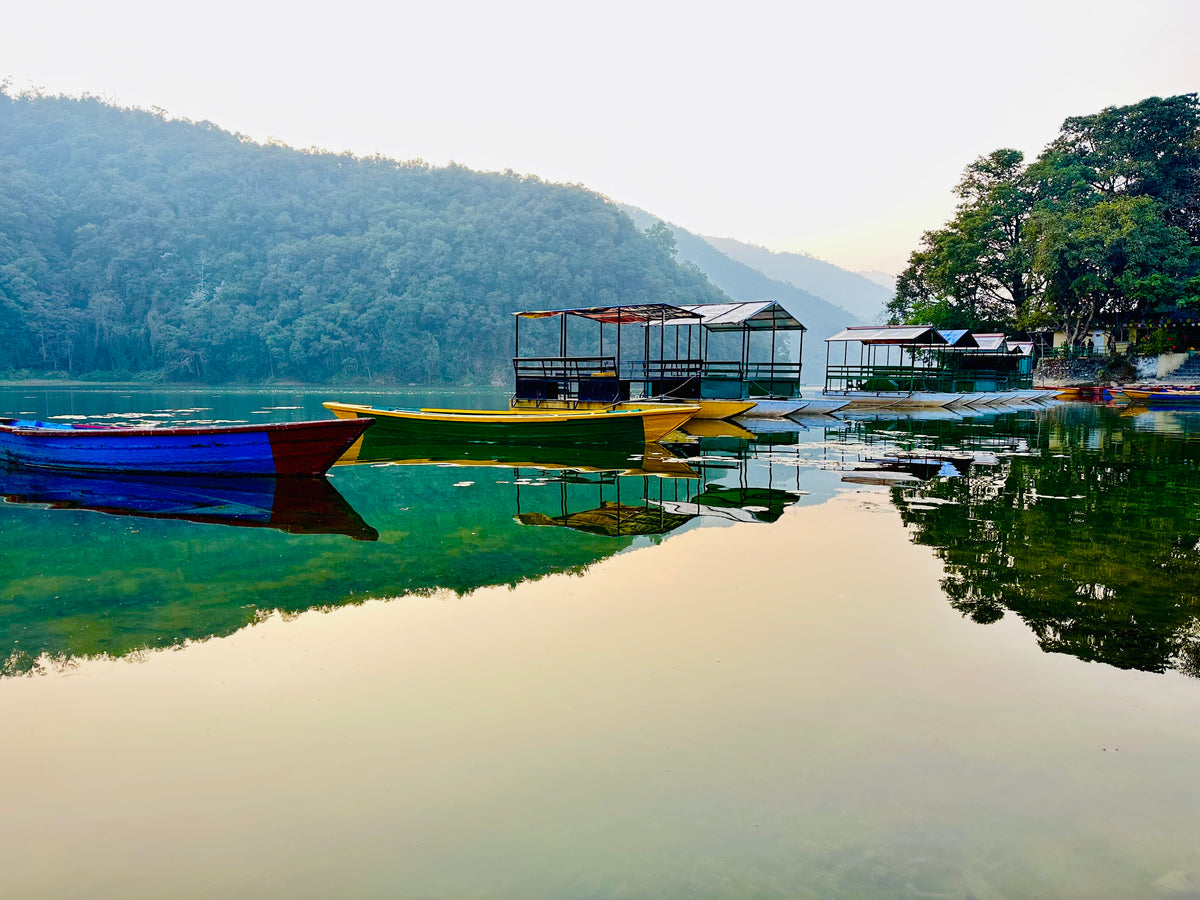
Boats and reflections on Phewa Lake, Pokhara, Nepal.
Krishna Mandir and Garuda column in Patan, Nepal.
Boats and reflections on Phewa Lake, Pokhara, Nepal.
Boudhanath stupa in Kathmandu, Nepal.
Annapurna range from Sarangkot, Nepal.
Entrance gate to Chitwan National Park, Nepal.
Rapti River at Sauraha, Nepal.
Himalayan horizon from Nagarkot, Nepal.
Nepal Premium Tour: Kathmandu, Chitwan and Pokhara route map

13 Days, Easy

13-Day Nepal Premium Tour: Kathmandu, Chitwan & Pokhara

From $3,575 per person

  • Next departure Apr 5, 2027
  • Join a group of up to 10, or go private. Large groups welcome.
Duration
13 Days
Best season
Spring & Autumn
Max altitude
2,175m (7,136ft)
Difficulty
Easy

Easy: sightseeing, short walks and gentle hill trails, or a first rafting trip. Nights below 3,000 m (10,000 ft).

We reply within one business day. No payment to ask.

Sherpa guides
Permits & logistics included
Private trips available
Altitude safety expertise
A US company, paid in dollars
Ask about this trip

Thirteen days across Nepal: the old cities of the Kathmandu Valley, jungle wildlife, Himalayan lakes, mountain sunrises, and the sacred caves of Padmasambhava.

Most Nepal itineraries focus on either the Kathmandu Valley’s temples or a trek, and treat the wildlife of Chitwan, the lakeside at Pokhara, the mountain views from Nagarkot, and the caves of Pharping as optional extras. This thirteen-day program includes all of them, because together they give you a full picture of the country.

The Kathmandu Valley days cover the seven UNESCO-listed monument zones within reach of the capital: Swayambhunath, Pashupatinath, Boudhanath, Kathmandu Durbar Square, Patan Durbar Square, Bhaktapur Durbar Square, and Changu Narayan. Each shows a different side of the culture and faith that the Newar people of the valley built over two millennia, and the itinerary gives you time to understand each one before moving on to the next.

Chitwan National Park, in the subtropical Terai lowlands, surprises most visitors who come expecting only mountains. The park is a UNESCO World Heritage Site and the main habitat of the greater one-horned rhinoceros, the Bengal tiger, the gharial crocodile, and over 500 bird species. You explore it by jeep safari and by canoe on the Rapti River, with naturalists who know the park and its animals well. A visit to a Tharu village rounds out the jungle days: the Tharu people of the Terai have lived alongside Chitwan’s wildlife for centuries, and their relationship with the forest is worth learning about in its own right.

Pokhara, Nagarkot, and Pharping complete the trip. From Sarangkot above Pokhara you watch the sun rise on the Annapurnas. Nagarkot, on the eastern rim of the valley, has a wider view of the eastern Himalaya, including Everest. At Pharping you visit the meditation caves of Padmasambhava, who carried his teachings from these hillsides to Tibet in the eighth century.

Road travel, rafting, wildlife activities and travel in remote places carry risks of illness, injury and death. Experienced staff, briefings and equipment reduce risk but cannot eliminate it. Your itinerary identifies your guide team, including Sherpa guides on Himalayan routes, and the support and equipment included.

SherpaHolidays Terms and Conditions SH-TC-2026-10-14. Your accepted booking version and mandatory rights remain in effect.

Thirteen Days, Seven UNESCO Monument Zones

Day 1 | Arrival in Kathmandu

Arrive at Tribhuvan International Airport, where the SherpaHolidays team gives you a traditional welcome and takes you to your luxury boutique hotel. The first evening is for rest and a briefing on the full thirteen-day itinerary: the order of destinations and activities, where you stay, and the practical arrangements. If you feel like a walk, the temples and lanes of Thamel are close to the hotel, with incense and cooking smoke in the air and, on a clear evening, the mountains above the city.

Days 2 to 3 | Kathmandu Valley

Two days for the valley’s UNESCO heritage sites. Swayambhunath, the hilltop stupa above the city, is one of the oldest Buddhist sites in Nepal. Pashupatinath, on the Bagmati River, is the most sacred Hindu site in the country; its cremation ghats, ochre-robed sadhus, and constant activity are worth taking slowly. Patan Durbar Square is known for the number and quality of its temples. Kathmandu Durbar Square holds the Kumari Ghar, home of the living goddess, and the Hanuman Dhoka palace complex. Bhaktapur, on the second day, adds the Golden Gate, the Nyatapola Pagoda, and the lanes of the best-preserved medieval city in the valley. If you take the optional Everest Mountain Flight on Day 2, it follows the Himalayan chain east from Kathmandu at sunrise.

Days 4 to 5 | Chitwan National Park

Drive south across the Terai to Chitwan National Park, a UNESCO World Heritage Site and the main stronghold of the greater one-horned rhinoceros in Nepal. The jeep safari goes into the tall grass and sal forest where rhinos and deer feed. The canoe trip on the Rapti River glides quietly past gharials and mugger crocodiles on the sandbars, with river birds at close range. On Day 5 you visit a Tharu village and meet the indigenous people of the Terai, whose knowledge of the jungle is centuries older than the park. Professional naturalists lead every activity.

Days 6 to 7 | Pokhara and Sarangkot

Drive west to Pokhara, where Phewa Lake sits below the southern face of the Annapurna range, with Machhapuchhre right above the far shore. On Day 7 you drive up to Sarangkot (1,592 meters) before first light for sunrise over the full Annapurna massif. After breakfast, a boat takes you out to the middle of Phewa Lake, where the peaks are reflected in the still morning water. David’s Fall and the Barahi Temple on its island round out the Pokhara days.

Days 8 to 10 | Nagarkot and Changu Narayan

On the way back toward Kathmandu, stop at Nagarkot (2,175 meters) on the eastern rim of the valley. At sunrise on Day 9 you can see Everest above the nearer ridges and the eastern Himalaya from Annapurna to Kanchenjunga, one of the widest mountain views you can reach by road from the capital. Changu Narayan, on its hilltop above Bhaktapur, is the oldest surviving temple in Nepal, and its fifth-century stone carvings of Vishnu are some of the best early Nepali religious sculpture. On Day 10 you go down to Kathmandu for the last days of the trip.

Days 11 to 13 | Pharping and Farewell

The caves at Pharping, south of Kathmandu, are the meditation caves of Padmasambhava, the Indian master who brought Vajrayana Buddhism to Tibet in the eighth century CE. Monks and practitioners still come every day to meditate in the Asura and Yanglesho caves below the village. On Day 12, a farewell dinner of traditional Newari food with a folk dance program, at one of the old city’s cultural restaurants, gives the trip a proper send-off. On Day 13 we take you to Tribhuvan International Airport for your departure.

Day by Day

Day 1 Kathmandu Arrival and Orientation

A SherpaHolidays representative meets you at Tribhuvan International Airport for a private transfer to your boutique hotel. That evening’s briefing is the first and most important meeting of the trip. It goes through the full thirteen-day itinerary in order: the altitude profile from the valley up to Nagarkot at 2,175 meters, the safari activities at Chitwan and what they ask of you physically, the predawn starts at Sarangkot and Nagarkot, where you stay, and the practical arrangements for luggage, meals, and transfers. Take the first evening gently. The lanes of Thamel are within walking distance of most central hotels, incense drifts from the nearby shrines, and on a clear evening you can see the mountains above the city. That is plenty for a first night.

Stay: Luxury Boutique Hotel in Kathmandu

Days 2 to 3 Kathmandu Valley UNESCO Heritage and Sacred Wonders

On the morning of Day 2, visit Swayambhunath, the oldest Buddhist site in the Kathmandu Valley. Its hilltop above the western edge of the city looks across the valley in every direction and was considered sacred before the medieval cities were built below it. You climb the 365 steps of the eastern staircase to the stupa with its painted eyes, past prayer wheels and stone carvings worn smooth by centuries of hands. In the afternoon, visit Pashupatinath, the most sacred Hindu site in Nepal and a working temple. The cremation ghats on the Bagmati River are in constant use, sadhus in ochre robes with ash-marked foreheads sit in the outer courtyards, and daily worship goes on around you with no museum or heritage signs in between.

On Day 3, visit Patan Durbar Square, known for the quality and variety of its temple architecture. Its stone courtyards, gilded roofs, the seventeenth-century Krishna Mandir, built entirely of stone in a northern Indian style, and the Patan Museum inside the palace make this one of the best mornings in the valley for anyone interested in religious art. In the afternoon, visit Kathmandu Durbar Square and the Kumari Ghar, where the living goddess, a young girl chosen through a strict traditional process, lives for the length of her tenure. The Hanuman Dhoka palace complex behind the square was the royal residence of the Shah dynasty, and its museum traces the history of the Kathmandu kingdom from the Licchavi period to the present century. Bhaktapur, the easternmost and best preserved of the three medieval cities, is worth a full day: the Nyatapola Pagoda, the tallest temple in Nepal, the Golden Gate at the entrance to the Palace of Fifty-Five Windows, and the Peacock Window on the nearby Pujari Math all reward a slow look at their craftsmanship. The optional Everest Mountain Flight leaves the domestic terminal early on Day 2 and follows the Himalayan chain east from Kathmandu at sunrise in a small plane, with the peaks from Everest (8,849 meters) to Kanchenjunga (8,586 meters) passing the windows one by one.

Stay: Luxury Boutique Hotel in Kathmandu

Days 4 to 5 Chitwan National Park Into the Wild

The drive south from Kathmandu crosses the Mahendra Highway through the Siwalik foothills to the Terai, the subtropical lowland at the foot of the Himalaya where the national park’s forest and grassland begin. Chitwan, established in 1973 and declared a UNESCO World Heritage Site in 1984, protects 952 square kilometers of sal forest, riverside grassland, and wetland, the main habitat of the greater one-horned rhinoceros in Nepal. A conservation program has brought the population back from fewer than 100 animals in the 1960s to nearly 700 today, one of the most successful large-mammal recoveries in Asia. Bengal tigers live in the park in numbers that make a sighting possible but not guaranteed, and a bird list of over 500 species makes Chitwan one of the best birding areas in the region.

On Day 4 the jeep safari goes into the tall grass and forest where rhinos, deer, and birds feed in the morning, when the animals are most active. Park naturalists explain everything you see, from the deer alarm calls that mean a predator is nearby to the feeding habits of the one-horned rhino. The canoe trip on the Rapti River on Day 5 is quieter: the dugout glides past gharials and mugger crocodiles on the sandbars and kingfishers and herons along the bank, on smooth water in the still of the morning. In the afternoon you visit a Tharu village. The Tharu, the indigenous people of the Terai, have lived close to the Chitwan jungle for centuries, and their traditional houses, handicrafts, and knowledge of the forest are as interesting as the park’s wildlife.

Stay: Premium Jungle Resort in Chitwan

Days 6 to 7 Pokhara and Sarangkot Lakeside Serenity

The drive west from Chitwan to Pokhara follows the Prithvi Highway along the base of the foothills, and the mountains appear above the valley rim as you near the lake. Pokhara, at 800 meters, sits closer to the high Himalaya than almost any other town its size in Nepal. The Annapurna range rises directly above the northern shore of Phewa Lake, and Machhapuchhre, the sacred unclimbed peak whose double summit gives it the local name Fishtail, stands close by in the center of the view. Spend the first afternoon by the lake, watching the peaks reflected in the late light. After the noise of Kathmandu and the early starts in the jungle, the quiet is welcome.

On Day 7 you leave before 5am and drive up the hillside in the dark to reach the Sarangkot viewpoint (1,592 meters) before the first light touches the peaks. At sunrise you see the full Annapurna massif, from Dhaulagiri in the west through Annapurna I, Annapurna South, Hiunchuli, Machhapuchhre, and Annapurna II to Lamjung Himal in the east, lit while the hills around you are still dark and the valley is in shadow. After breakfast, a boat takes you to the middle of Phewa Lake to see the same peaks reflected on the water. The Barahi Temple, on its small island, is reached by rowing boat; it is an active Hindu temple and the most visited spot on the lake. Nearby is David’s Fall, where the Phusre Khola disappears into a cave at the edge of the city, one of the features of the karst rock beneath the Pokhara valley.

Stay: Luxury Lakeside Hotel in Pokhara

Days 8 to 10 Nagarkot and Changu Narayan Himalayan Horizons

The drive back from Pokhara follows the Prithvi Highway east through the middle hills. Instead of going straight to the capital, you continue to Nagarkot (2,175 meters) on the eastern rim of the Kathmandu Valley, a hill resort above a forested ridge with one of the widest mountain views you can reach by road from Kathmandu. On a clear morning the view runs from the Annapurna range in the west to Kanchenjunga in the east, with Everest (8,849 meters) above the nearer ridges in the middle. Watch the sunrise on Day 9 from the resort viewpoint or from the tower at the end of the ridge, as the peaks come out of the predawn blue and the first light moves across the eastern Himalaya while the valley below is still in shadow.

Changu Narayan, on its hilltop above the Bhaktapur valley, is the oldest surviving temple complex in Nepal. The main Vishnu shrine dates to the fifth century CE, and its Licchavi stone carvings are among the best early religious sculpture in the country. The courtyard holds carvings from fifteen centuries, including a multi-armed Vishnu from the Licchavi period that appears in most books on early South Asian sculpture. The walk up through the forest from the road takes twenty minutes and ends at a hilltop with views over the Bhaktapur valley and the Kathmandu Valley beyond the ridge. On Day 10 you go down to Kathmandu for the last days of the trip.

Stay: Scenic Hillside Resort in Nagarkot then Luxury Boutique Hotel in Kathmandu

Days 11 to 13 Pharping and Farewell Spiritual Reflection and Departure

The caves at Pharping, in the Dakshinkali valley south of Kathmandu, are associated with Padmasambhava, the Indian master credited with bringing Vajrayana Buddhism to Tibet in the eighth century CE. Tradition holds that he practiced and attained realization in the Asura Cave, lower on the hillside, and the Yanglesho Cave above it before carrying the teachings north across the Himalaya. Both caves are in daily use: monks and practitioners come to meditate where the founder of their lineage did. The Dakshinkali valley around them, with Newar farming terraces and the Dakshinkali temple on the valley floor, shows you the rural side of the Kathmandu Valley that the city days miss.

On the evening of Day 12, the farewell dinner at a traditional Newari restaurant in the old city of Kathmandu brings the trip to a close. The food is Newari, the cooking of the Kathmandu Valley’s indigenous people: beaten rice, buffalo dishes, fermented vegetables, and lentils cooked in clay pots, a tradition distinct from Nepal’s national cuisine and little known outside the valley. The set menu comes with a program of classical Newari dances, whose forms and music follow the religious calendar of the valley’s temples. On Day 13 we take you to Tribhuvan International Airport for your departure, with a last look at the mountains above the city if the morning is clear.

Stay: Luxury Boutique Hotel in Kathmandu

The Sherpa Standard

Every SherpaHolidays trip is fully supported from arrival to departure. Here is what that means on this one.

Accommodation and Meals

  • City and Hill Hotels: A luxury boutique hotel in Kathmandu on arrival and return, a luxury lakeside hotel in Pokhara, and a scenic hillside resort at Nagarkot.
  • Jungle Resort: Two nights at a premium jungle resort on the edge of Chitwan National Park, with the full naturalist program and evening talks on the park’s ecology.
  • Daily Breakfast: A full breakfast at all hotels and resorts throughout the thirteen days.
  • Full Service at Chitwan: Refreshments, full briefings, and complimentary services at the jungle resort during your Chitwan stay.
  • Farewell Dinner: A farewell dinner on Day 12 in Kathmandu with Newari food and a traditional folk dance program.

Leadership and Support

  • City Heritage Guide: A dedicated, professional English-speaking local guide for all sightseeing in the Kathmandu Valley, Bhaktapur, Pokhara, Nagarkot, and Pharping.
  • Wildlife Naturalists: Experienced naturalists and park rangers at Chitwan to lead the jeep safari, canoe trip, Tharu village visit, and nature walks, with slideshow talks on the park’s ecology and natural history.
  • Well-Staffed Safaris: Road travel, rafting, wildlife activities and travel in remote places carry risks of illness, injury and death. Experienced staff, briefings and equipment reduce risk but cannot eliminate it. Your itinerary identifies your guide team, including Sherpa guides on Himalayan routes, and the support and equipment included.

Transport and Access

  • Private Transfers: All ground transportation in a comfortable private vehicle for all thirteen days, including airport pickup, drives between cities, and sightseeing transfers.
  • Heritage Access: All entrance fees to UNESCO World Heritage Sites, temples, and monuments.
  • Park Permits: National park entry fees and all the permits you need for Chitwan.


What Is Not Included

  • International airfare to and from Kathmandu and Nepal entry visa fees
  • Optional activities: the Everest Mountain Flight, paragliding from Sarangkot, or helicopter tours
  • Lunch and dinner in Kathmandu and Pokhara, except the farewell dinner
  • Comprehensive travel insurance, which is a condition of every booking. Your policy must cover emergency medical treatment, emergency evacuation, trip cancellation and interruption, and repatriation.
  • Tips for guides, drivers, and resort staff, plus personal shopping, souvenirs, and laundry
  • Single supplement (for those taking a private room)

Five Highlights

The Everest Panorama from Nagarkot

Nagarkot, at 2,175 meters on the eastern rim of the Kathmandu Valley, has one of the widest mountain views you can reach by road from the capital. On a clear morning you can see from Annapurna in the west across the eastern Himalaya to Kanchenjunga, with Everest (8,849 meters) above the nearer ridges. At sunrise the peaks come out of the predawn blue and catch the first light while the valley below is still in shadow. It is a wider, more distant view than the close one at Sarangkot, and this trip gives you both.

Wildlife in Chitwan

Chitwan National Park is the main stronghold of the greater one-horned rhinoceros in Nepal, and the population has recovered from fewer than 100 animals in the 1960s to nearly 700 today. A morning jeep safari takes you through the grassland and forest where the rhinos feed. The canoe trip on the Rapti River glides quietly past gharials and mugger crocodiles on the sandbars, with some of the best morning birding in the region along both banks. Professional naturalists lead every activity, and the Tharu village visit adds the people of the Terai to the wildlife.

Seven UNESCO Monument Zones

Nepal has four UNESCO World Heritage Sites, and this thirteen-day trip visits two of them: the Kathmandu Valley, with its seven monument zones, and Chitwan National Park. Swayambhunath, the hilltop stupa, has stood above the Kathmandu Valley for over two thousand years. At Pashupatinath, the most sacred Hindu site in Nepal, cremation fires burn continuously on the Bagmati River. Boudhanath, the great stupa, is the center of the Tibetan Buddhist community in exile. The Durbar Squares of Kathmandu, Patan, and Bhaktapur are three medieval royal cities within a few kilometers of one another. Chitwan National Park is the subtropical wildlife reserve below the Himalayan foothills. Changu Narayan, the oldest temple complex in Nepal, still has its fifth-century Licchavi sculpture in place. Each is different, and none can be seen properly in an hour.

The Caves of Pharping

The Asura and Yanglesho caves below the village of Pharping are the meditation caves of Padmasambhava, the Indian master who brought Vajrayana Buddhism to Tibet in the eighth century CE. Every school of Tibetan, Bhutanese, and Mongolian Buddhism holds that he attained realization here before crossing the Himalaya to carry the teachings north. Monks and practitioners still meditate in the caves every day. The visit comes on Day 11, after twelve days that have taken in the Kathmandu Valley’s Hindu and Buddhist sites, Chitwan’s wildlife, and the mountain views from Sarangkot and Nagarkot, and it is a quiet way to finish the trip.

The Annapurnas from Pokhara

In the early morning, before the wind picks up, Pokhara’s Phewa Lake reflects the whole southern face of the Annapurna range, with the sacred pyramid of Machhapuchhre right above the far shore. The predawn drive up to Sarangkot (1,592 meters) gets you there for sunrise over the whole massif: Dhaulagiri in the west, Annapurna I through IV in the center, and Lamjung Himal in the east, lit while the hills around you are still in shadow. After breakfast, a boat on Phewa Lake gives you the same peaks from the water, reflected below and rising above, at a slower pace. Seeing the Annapurnas twice in one day is one of the high points of the trip.

Travel dates

The deposit is part of the total price, not an additional fee.

  • April 5 – 17, 2027 Available
    $3,575 per person
  • May 3 – 15, 2027 Available
    $3,575 per person
  • October 4 – 16, 2027 Available
    $3,575 per person
  • November 1 – 13, 2027 Available
    $3,575 per person

Scheduled departure deposit: $500 per person for bookings more than 90 days before departure

Private journey deposit: 30% of the trip price for bookings more than 90 days before departure

Final balance: Due 90 days before departure. Bookings made 90 days or fewer before departure are paid in full at booking.

Our conditions promise: A qualifying Nepal advisory change or trek-region closure within 60 days of departure lets you move dates free or take full credit for 24 months.

Scheduled departures: No minimum group size

SherpaHolidays Terms and Conditions SH-TC-2026-10-14. Your accepted booking version and mandatory rights remain in effect.

Questions about this trip?

Ask Sam or Gyalgin

We reply within one business day. No payment, no commitment.

Loading the inquiry form…

This is an inquiry, not a booking. Nothing is charged here.

  • Within one business day We reply within one business day.
  • Then A call, if you would like one.
  • When you are ready A deposit holds your place.

Or talk to us directly:

+1 (855) 743-7725 info@sherpaholidays.com

Things guests ask before booking

Straight answers about booking, payment and how we run every trip.

  • It is a relaxed sightseeing tour with no trekking. Most days are walks around temples, old squares and lakeside towns with your guide. A few mornings start early for sunrise, at Sarangkot above Pokhara and at Nagarkot. The highest point is Nagarkot at 2,175 meters (7,136 ft). Read your trip's walking demands, highest daytime and sleeping altitudes, terrain, technical requirements and gear list before booking. Seek advice from a clinician familiar with your health and altitude travel.

  • In a boutique hotel in Kathmandu, a lakeside hotel in Pokhara, a hillside resort at Nagarkot, and a jungle resort on the edge of Chitwan National Park for two nights. Ask us for the hotel names on your dates. We confirm hotels for your dates because availability changes. You stay in the named hotel or a similar one.

  • Yes, on request. Tell us when you book.

  • Breakfast is included every day at every hotel and resort. Lunch and dinner in Kathmandu and Pokhara are on your own, so you can try local restaurants.

  • In a private vehicle for all thirteen days, including the airport pickup and the drives between Kathmandu, Chitwan, Pokhara and Nagarkot. A private English-speaking guide leads the sightseeing, and naturalists lead the activities at Chitwan.

  • The optional Everest Mountain Flight, paragliding from Sarangkot and helicopter tours. Tips, shopping and laundry are also on you.

  • Groups of up to 10, or private for your own group. Scheduled group dates have no minimum, so they run with any number of guests. Large groups welcome.

  • The deposit is part of the total price, not an additional fee. A scheduled booking made more than 90 days before departure requires $500 per person. A private journey booked more than 90 days before departure requires 30% of the trip price. The balance is due 90 days before departure. At 90 days or fewer, full payment is due at booking. Your disclosure and invoice state the exact amounts and dates.

    Once your deposit is received, your price is locked except for government taxes, park fees or levies introduced after that date. We tell you in writing as soon as we learn of one and identify its amount and basis. A different route, hotel upgrade or optional activity is not an automatic extra charge; any additional cost requires your agreement before it is booked.

    SherpaHolidays Terms and Conditions SH-TC-2026-10-14. Your accepted booking version and mandatory rights remain in effect.

  • Scheduled departure deposit
    $500 per person for bookings more than 90 days before departure

    Private journey deposit
    30% of the trip price for bookings more than 90 days before departure

    Final balance
    Due 90 days before departure. Bookings made 90 days or fewer before departure are paid in full at booking.

    You cancel 90 or more days before departure
    Your deposit becomes credit toward any SherpaHolidays trip for 24 months. Payments above the deposit are refunded, subject only to a specific supplier exception disclosed and accepted before payment.

    You cancel 89 to 60 days before departure
    Cancellation charge: 50% of the total trip price

    You cancel 59 to 46 days before departure
    Cancellation charge: 75% of the total trip price

    You cancel 45 days or fewer before departure
    Cancellation charge: 100% of the total trip price. No refund.

    Our conditions promise
    A qualifying Nepal advisory change or trek-region closure within 60 days of departure lets you move dates free or take full credit for 24 months.

    We cancel or cannot provide contracted services
    Refunds for services not provided as required by California law. An alternative or credit is your choice, not a required substitute.

    Scheduled departures
    No minimum group size

    The traveler-cancellation table does not remove our conditions promise, rights under an already accepted booking, or refunds and other rights required by law.

    If the US State Department raises Nepal to Level 3 or higher, or your trek region is closed, within 60 days of departure, you can move your dates free or take full credit toward any SherpaHolidays trip for 24 months. This applies instead of the normal traveler-cancellation charges, including the 45-day rule and any supplier cancellation exception.

    Full credit means the payments you made for the affected trip, not only the deposit. We record the trigger and your choice in writing. The credit follows Section 4's use and validity terms. A free date move has no change fee; we disclose any price difference for the replacement trip before you decide. The promise does not replace a cash refund owed when we cancel or cannot provide contracted services.

    SherpaHolidays Terms and Conditions SH-TC-2026-10-14. Your accepted booking version and mandatory rights remain in effect.

  • Comprehensive travel insurance is a condition of every booking. Your policy must cover emergency medical treatment, emergency evacuation, trip cancellation and interruption, and repatriation. Confirm with your insurer that it covers your itinerary's activities and maximum altitude, including technical climbing, rafting, helicopter evacuation and search and rescue where applicable. Provide proof before departure. Consider obtaining cover when you book because some benefits have purchase deadlines.

    We are not your insurer. Receiving your documents is not a determination of coverage and does not guarantee payment of a claim. Medical and evacuation providers may require payment in advance. Keep insurer emergency details available during your trip.

    SherpaHolidays Terms and Conditions SH-TC-2026-10-14. Your accepted booking version and mandatory rights remain in effect.

  • Yes. Any departure can run privately on your dates, and we adjust pace, accommodation and rest days around you. If you want a different route entirely, we plan custom itineraries from scratch.

  • Guides from our own Sherpa team lead every trip in Nepal. Beyond Nepal we work with trusted local partners we have known for years, so there is always someone beside you who knows the ground well.

  • The Sherpa Standard section on this page lists everything included on this trip, from guides and permits to lodges and meals. International flights and travel insurance are the main things you arrange yourself.

Guest reviews

What guests say

5.0 average from 5 Google reviews
Read them on Google
I recently took a trip to Nepal and was met with wonderful service by the staff and amazing tours with the Sherpa guides. The cultural tours were by far my favorite. Highly recommend!!
Avin Fatehi
Took a trip to Nepal for 10 days and got an amazing tour of the area! Great people, great places 10/10 would go again 🔥🔥
Kevin Ye
I found Sherpa Holidays when I was looking to do the 23 days Annapurna circuit trek and they not only made me a custom itinerary to fit my needs, but they also made the entire process seamless. Highly recommend Sherpa Holidays for anyone looking to head to Nepal!
Justin Zhang
The staff were easy to communicate with and I had a wonderful trip.
Jack Cavada

Reviews shown as published on our Google profile.