
Hikers with backpacks walking on a trail with mountains in the background
Snow-capped mountains with a clear blue sky and greenery in the foreground.
Hikers with backpacks walking on a trail with mountains in the background
Snow-capped mountain peak with a clear blue sky
Stone lion statues in front of a traditional building with intricate carvings.
Stone cairn on a dirt path with trees and mountains in the background
Mountain range with snow peaks partially covered by clouds
Village nestled in a mountainous area with colorful buildings and greenery.
Map of a trekking route with various locations marked on a yellow background
FREE CANCELLATION UP TO 30 DAYS BEFORE DEPARTURE. FULL TERMS APPLY.

18-Day Everest Base Camp Premium Trek

Starting From
$3,975.00
Duration
18 Days
Best Season
Autumn
Max Altitude
5,550m (18,208ft)
Comfort Level
Challenging (High-altitude trek)
Dates & Prices


Full payment at booking secures your permits, private guides, and all logistics before your departure date.

Licensed Sherpa Guides
Permits & Logistics Included
Private Journeys Available
Altitude Safety Expertise

The world’s highest peak, approached on foot through the heartland of the Sherpa people. This is the trek that defined Himalayan adventure.

Everest Base Camp is the most famous trekking destination in the world. It is famous for reasons that become clear within the first days of walking: the approach through the Khumbu delivers one remarkable sight after another, faster than you can take them all in. The forests of rhododendron and giant fir along the Dudh Kosi. Namche Bazaar on its hillside above the gorge. The first view of Everest above the ridge. Tyangboche Monastery with Ama Dablam rising above it. The glacier terrain of the upper Khumbu. And then, at the end of it all, the flat moraine of Gorak Shep and the walk to base camp at the foot of the icefall.

The trek follows the route that Edmund Hillary and Tenzing Norgay walked before their 1953 ascent, the same approach that every Everest expedition since has used, and the same villages and landscapes that the Sherpa people have inhabited for centuries. The communities along the trail, from the trading families of Namche to the farming villages of Khumjung and Kunde, have a relationship with the mountain that predates the history of its climbing by several hundred years. Walking through them is walking through a living culture that the mountain has shaped as much as the mountain has been shaped by those who have climbed it.

The acclimatization schedule built into this expedition is deliberate and unhurried. High-altitude trekking rewards patience, and the rest days at Namche Bazaar, Khumjung, and Dingboche are what get the group to base camp in good physical condition rather than exhausted and altitude-sick. The optional ascent of Kala Patthar at 5,550 meters the morning before base camp provides the iconic close-up view of Everest’s summit pyramid that the base camp itself does not offer. Both are part of what makes the upper Khumbu worth the effort of reaching.

The return follows the same trail as the approach but feels different in every respect. The altitude is decreasing rather than increasing. The body is stronger than it was two weeks earlier. The landscape that was new and astonishing on the way up is now familiar, and familiarity reveals details that urgency concealed. The final flight back to Kathmandu, the celebratory dinner, and the last days in the valley close an expedition that most people who complete it rank among the most significant physical experiences of their lives.

18 Days to the Foot of the Highest Mountain on Earth

Days 1 to 3 | Kathmandu

Arrive in Kathmandu for the expedition briefing and three days in the Kathmandu Valley. Swayambhunath, Pashupatinath, Boudhanath, and the Durbar Squares of Kathmandu and Patan are more than sightseeing stops: the Buddhist and Hindu traditions visible in these sites are the same traditions that built the gompas of Tyangboche and Khumjung and that the Sherpa communities of the Khumbu have maintained without interruption for centuries. The valley is worth this attention on its own terms, and arriving at Tyangboche Monastery with some understanding of what it represents makes the visit mean far more.

Days 4 to 6 | Lukla to Khumjung

The mountain flight from Kathmandu to Lukla is the approach to the Khumbu in miniature: a dramatic entry into the high terrain that sets the character of the days ahead. The trek from Lukla follows the Dudh Kosi River through rhododendron and magnolia forest to the suspension bridges and teahouse villages of the lower valley. Namche Bazaar at 3,440 meters is the commercial and cultural hub of the Sherpa world, and the acclimatization day here is spent with a walk up to Khumjung at 3,780 meters: a traditional Sherpa village above the trading town, its community shaped by mountaineering, Gurkha service, and the Hillary School that stands at the center of the settlement. The first clear views of Everest, Lhotse, Nuptse, and Ama Dablam appear from the ridge above Namche on this day.

Days 7 to 11 | Tyangboche to Lobuche

The trail from Namche descends into the Dudh Kosi gorge and climbs the far side through mossy forest to the saddle at Tyangboche, where the most important monastery in the Khumbu stands with Ama Dablam rising directly above it. Above Tyangboche the vegetation simplifies and the altitude begins to register in the pace of the walking. Dingboche at 4,220 meters has an acclimatization day built into the schedule, with the option to walk higher toward Chukhung for additional altitude gain before rest. The final approach to Lobuche at 4,930 meters follows the lateral moraine of the Khumbu glacier through terrain that has thinned to rock, scrub, and the wide sky of the high Himalaya.

Days 12 to 13 | Kala Patthar and Everest Base Camp

The predawn climb to Kala Patthar at 5,550 meters is the summit view: Everest’s full pyramid above the Nuptse ridge in the first light, the South Col visible, the route of ascent legible. The walk to Everest Base Camp the following day follows the moraine of the Khumbu glacier from Gorak Shep to the foot of the icefall at 5,300 meters. The base camp is where every Everest expedition since 1953 has begun. Standing at it, with the glacier below and the icefall above, the scale of the mountain finally registers in a way no photograph manages.

Days 14 to 18 | The Descent and Return

The return from base camp retraces the approach through Lobuche, Dingboche, Tyangboche, and Namche, the body stronger than it was on the way up and the pace noticeably easier. The final night in the mountains is at Lukla, and the following morning’s flight back to Kathmandu arrives in time for a last day of sightseeing in Patan and Bhaktapur before the international departure. The expedition concludes with a traditional Nepali dinner and the kind of conversation that happens when a group of people have shared something genuinely demanding together.

Day by Day

Days 1 to 3 Kathmandu The Sacred Valley

Arrive at Tribhuvan International Airport and transfer to the hotel with a welcome from the SherpaHolidays team. The expedition briefing that first evening is the starting point for everything that follows: the full 18-day route is covered in detail, including the altitude profile from Lukla to Kala Patthar, the acclimatization strategy, the daily distances and elevation changes, the lodge accommodation along the route, and the physical demands of the upper Khumbu. The Everest trek is the most popular high-altitude trekking route in the world, but popular does not mean easy, and the briefing prepares guests for what the altitude will require of them from Namche upward.

Swayambhunath occupies a hilltop above the western edge of Kathmandu, its white stupa and the golden tower above it visible from much of the city. The site has been a center of Buddhist practice for over two thousand years. The monkeys that give it its common name live in the trees on the hillside below the main complex and have been there long enough to be considered part of the place. Pashupatinath on the Bagmati river is Nepal’s most sacred Hindu site: the ghats where the dead are cremated and the courtyards where sadhus receive visitors give it an atmosphere found nowhere else in the world. Boudhanath, the great stupa on the eastern edge of the city, is one of the largest in the world and has been the center of the Tibetan Buddhist community in Kathmandu since the exile of 1959. The medieval streets of Kirtipur, the old city on a ridge above the valley, are less visited and better preserved for it. All of this is the cultural foundation for the mountains ahead.

Stay: Luxury Hotel in Kathmandu

Days 4 to 6 Lukla to Khumjung The Sherpa Heartland

The morning flight from Kathmandu to Lukla departs early, before the valley cloud builds and closes the mountain airstrips. The aircraft tracks east over the middle hills, the terrain rising below as the foothills give way to the approach ranges of the Khumbu, and descends in the final approach along the hillside to the Lukla runway at 2,840 meters. The landing is firm and the airstrip is short. Lukla itself is a busy, purposeful place: lodges and outfitters line the single main street, porters organize their loads in the square below the runway, and the trail north into the Khumbu begins immediately beyond the stone gateway at the top of the village.

The trail from Lukla follows the Dudh Kosi River through some of the finest valley forest in Nepal. Rhododendron, magnolia, and giant fir cover the slopes on both sides of the river, the trees large and old in the sections that have been protected within the national park. The river runs fast and loud below the suspension bridges that carry the trail between the banks, its water grey with glacial silt from the high peaks above. The villages of Phakding and Monjo appear at regular intervals along the trail, their stone houses and teahouse gardens familiar staging posts for a route that has been in use since long before the first trekking expeditions of the 1960s.

Namche Bazaar at 3,440 meters is the Sherpa capital: a horseshoe-shaped bowl on the hillside above the Dudh Kosi gorge, its tightly packed lodges, bakeries, and expedition outfitters filling every available level of the natural amphitheater. The Saturday market in Namche, when Tibetan traders bring goods down from the high plateau and valley people bring produce up from below, has been running for generations and remains the commercial heart of the Khumbu. The acclimatization day at Namche is spent with a walk up to Khumjung at 3,780 meters, the largest traditional Sherpa village in the region. From the ridge above Khumjung, Everest, Lhotse, Nuptse, and Ama Dablam are all visible on a clear morning: the first time the great peaks of the upper Khumbu appear as a collective presence rather than distant shapes above the ridgeline.

Stay: Best Available Mountain Lodges

Days 7 to 11 Tyangboche to Lobuche The Final Approach

The trail from Namche to Tyangboche descends first into the Dudh Kosi gorge on a path that drops steeply through juniper and fir before crossing the river and climbing the far side through increasingly mossy forest to the saddle at 3,860 meters. Tyangboche Monastery is the most important religious institution in the Khumbu: its position on a forested platform with Ama Dablam rising immediately above and the Everest group visible to the north makes it one of the most dramatically positioned buildings in Nepal. The monastery was founded in the early twentieth century and rebuilt after a fire in 1989. The monks who maintain daily practice here are part of a Tibetan Buddhist tradition that the Sherpa people brought across the Nangpa La from Tibet several centuries ago. Watching the evening puja from the courtyard of the gompa, the butter lamps lit and the chanting audible from outside, stays with you no matter how many photographs of it you have seen.

Above Tyangboche the forest thins and then gives way to open alpine meadow. The peaks are fully visible now on all sides, their scale and proximity increasing with every day of ascent. Dingboche at 4,220 meters sits in a wide valley below the Imja Khola glacier, its stone-walled potato and barley fields evidence of the sustained effort the Sherpa people have put into making agriculture viable at this altitude. The acclimatization day at Dingboche is important: the body needs the rest and the altitude gain, and the optional walk toward Chukhung at 4,730 meters provides additional acclimatization without requiring a full day of trekking distance.

The trail from Dingboche to Lobuche follows the lateral moraine of the Khumbu glacier through the Khumbu Valley. The vegetation here has simplified entirely: lichens on the boulders, low scrub in the hollows, and the bare rock of the moraine beneath the feet. The Pyramid Research Station appears on a hillside above the trail. The memorial cairns for climbers lost on Everest line the ridge above Lobuche: a long row of stone monuments with inscribed plaques that serve as an understated record of what the mountain has cost over the decades of its climbing history. Lobuche at 4,930 meters is the last lodge settlement before the glacier terrain of the upper Khumbu, its handful of stone buildings providing the final comfortable night before the highest section of the trek.

Stay: Best Available Mountain Lodges

Days 12 to 13 Kala Patthar and Everest Base Camp The Summit View

The walk from Lobuche to Gorak Shep crosses the terminal moraine of the Khumbu glacier on a trail that gains altitude steadily through loose rock and gravel. Gorak Shep at 5,140 meters is the last stop: a flat sandy plain above the glacier with a handful of lodges that serve meals and hot drinks to groups in various stages of acclimatization. The predawn start for Kala Patthar the following morning requires an early alarm and the discipline to move in the cold and dark before the day’s warmth arrives. The ascent to 5,550 meters takes two to three hours at the pace that altitude requires, and the summit ridge arrives with the first light already touching the peaks above. The view of Everest from Kala Patthar is the clearest and most direct available to a trekker in Nepal: the full summit pyramid above the Nuptse ridge, the South Col visible on the left skyline, the route of the 1953 ascent legible to anyone who knows what to look for.

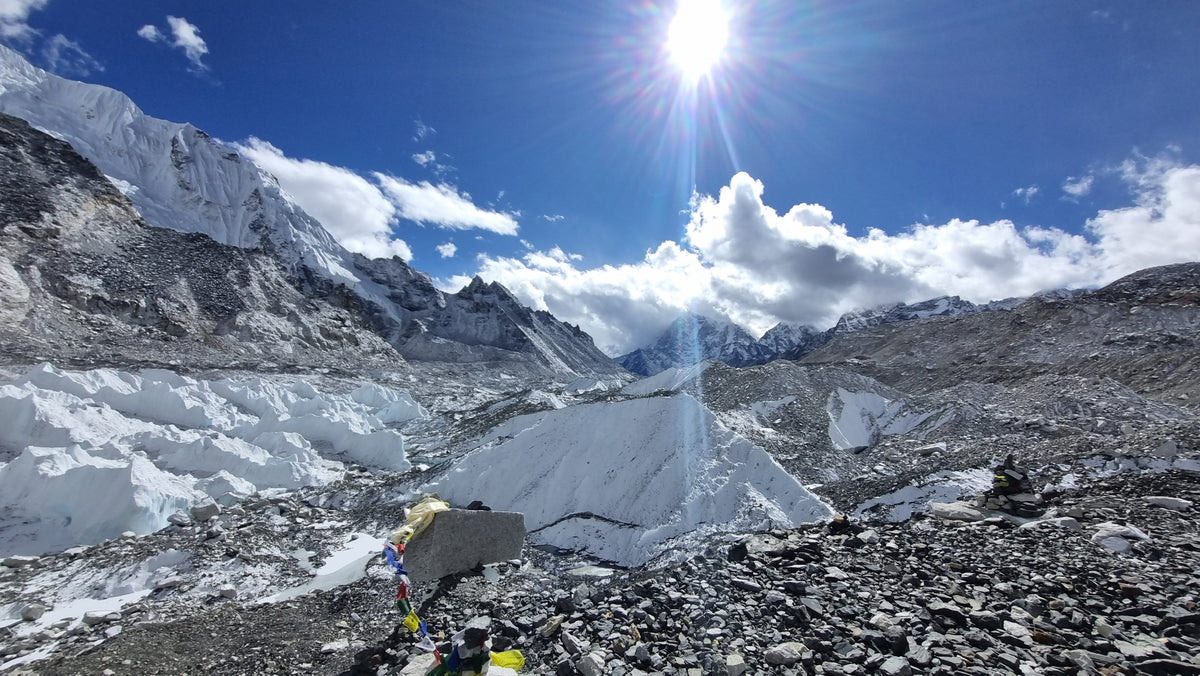
Everest Base Camp is reached the same day, in the afternoon after the descent from Kala Patthar. The walk from Gorak Shep follows the moraine alongside the Khumbu glacier to the flat expanse at 5,300 meters where the expedition tents are pitched during the climbing season. Outside the season, from October to February, base camp is unmarked on the ground: a wide area of moraine at the foot of the icefall, the glacier calving and shifting audibly below, the route up through the seracs closed and white above. What is here at any time of year is the scale of the place and the knowledge of what it represents in the history of mountaineering. Standing at the foot of the Khumbu Icefall, looking up at the route that every Everest expedition has used since 1953, is the defining moment of this trek.

Stay: Best Available Mountain Lodge at Gorak Shep

Days 14 to 18 Lobuche to Kathmandu The Homeward Trail

The descent from base camp and Gorak Shep retraces the approach through Lobuche and the moraine terrain of the upper Khumbu. The body on the way down is noticeably different from the body on the way up: the altitude is decreasing rather than increasing, the muscles are strong from two weeks of daily walking, and the pace is noticeably easier. The landscape that required all available attention on the ascent is now familiar, and the familiarity lets you notice more: the details of the rock formations, the quality of the light on the peaks in the afternoon, the sound of the glacier that was background noise on the way up.

Tyangboche on the descent has a different character from Tyangboche on the ascent. The urgency of gaining altitude is gone. The monastery, seen now from the vantage of having been above it for a week, looks smaller and somehow more remarkable for the scale of what surrounds it. The forest below Tyangboche smells of moisture and vegetation after the dry air of the high Khumbu. Namche Bazaar, when it reappears on the hillside above the gorge, is almost welcoming. The final night in the mountains is at Lukla, and the following morning the flight to Kathmandu returns the group to the valley in time for a last day in the city.

Patan and Bhaktapur are the two best-preserved medieval cities in the Kathmandu Valley, and arriving at them after two weeks in the high Khumbu makes them feel even richer. The stone courtyards, the carved timber, the pagoda temples, and the life of the streets around them look different after altitude and moraine and glacier. The traditional Nepali dinner that concludes the expedition, with the full guide and support team present, is a proper celebration of what the group has done together. The international departure the following morning completes the journey.

Stay: Best Available Mountain Lodges then Luxury Hotel in Kathmandu

The Sherpa Standard

This trek is fully supported from the day you land in Kathmandu to the day you fly home. Here is what that covers on the Everest route.

Accommodation and Meals

  • Kathmandu: 4 nights at the Malla Hotel or similar in Kathmandu on a bed and breakfast basis.
  • Mountain Lodges: 12 nights in the best available high-altitude lodges along the route, hand-selected by the SherpaHolidays team for comfort and location.
  • Full Board on Trek: All meals throughout the 18-day expedition, including breakfast, lunch, and dinner, featuring a mix of traditional Nepali and international dishes freshly prepared at each lodge.

Leadership and Support

  • Expedition Guide: One experienced, licensed English-speaking trekking guide with deep knowledge of the Khumbu region, Sherpa culture, and the demands of high-altitude walking, for the full duration of the trek.
  • Sherpa Support Team: Professional porters at one per two guests, handling all personal luggage and expedition logistics throughout.
  • Staff Ethics: Comprehensive insurance coverage for all local Sherpa guides and porters as standard.

Transport and Permits

  • Private Transfers: All arrival, departure, and sightseeing transfers in Kathmandu by private vehicle.
  • Guide Flights: Return flight tickets for the trekking guide on the Kathmandu to Lukla route.
  • Heritage Access: All heritage site and monument entry fees for Kathmandu Valley sightseeing fully covered.


What Is Not Included

  • International airfare to and from Nepal
  • Guest flight tickets for Kathmandu to Lukla and return, available as a supplement
  • Everest Conservation Area and Sagarmatha National Park entry fees
  • Lunch and dinner in Kathmandu, and drinks throughout
  • Travel and emergency evacuation insurance, which is mandatory for this expedition. We can recommend providers.
  • Tips for guides and porters, personal trekking equipment, and souvenirs
  • Single supplement (for those taking a private room)

Five Things That Define This Trek

Everest Base Camp

Base camp at 5,300 meters is where every successful ascent of Everest has begun since the first expeditions of the early 1950s, and the Khumbu Icefall above it shows you the scale and seriousness of the mountain in a way no photograph taken from below can. The glacier is audible at base camp: the ice shifts and settles and occasionally cracks in a way that makes the frozen surface feel alive. Standing here, at the foot of the highest mountain on earth, is the moment this expedition has been building toward since the first day out of Lukla.

Kala Patthar at Sunrise

The predawn climb to Kala Patthar at 5,550 meters is the defining experience of the upper Khumbu. The cold start, the headlamps on the dark trail, the slow gain of altitude in air that is at roughly half sea-level density, and then the arrival at the summit ridge as the first light touches the peaks above: trekkers have repeated this sequence for sixty years, and it has lost none of its power. The view of Everest from Kala Patthar is the clearest available on foot in Nepal: the full pyramid of the summit above the Nuptse ridge, the South Col visible, the scale of the mountain finally, fully apparent.

Tyangboche Monastery

The most important religious institution in the Khumbu stands on a forested saddle at 3,860 meters with Ama Dablam rising directly above and the Everest group visible to the north. The setting is among the finest of any building in Nepal, and the monastery itself is a living institution: the monks conduct daily practice, the butter lamps are lit at the evening puja, and the community around the gompa has maintained its traditions without interruption since the early twentieth century. The Sherpa people brought the Tibetan Buddhist practice visible at Tyangboche across the Nangpa La from Tibet several hundred years ago. Walking through the monastery courtyard with that history in mind gives the place a weight that photos alone never capture.

Namche Bazaar and the Sherpa World

Namche Bazaar is the commercial and cultural center of the Khumbu, a horseshoe-shaped settlement on the hillside above the Dudh Kosi gorge that has been at the intersection of the high and low Himalayan trading worlds for centuries. The families that run the lodges and outfitters of Namche are the same families that have supplied and guided Everest expeditions since the 1950s, their knowledge of the mountain and its approaches accumulated across generations. The Saturday market, the bakeries, the expedition gear shops, and the continuous movement of trekkers, porters, and yak caravans through the town give Namche a vitality that no other settlement on the route possesses. It is worth an extra day.

The Forests of the Dudh Kosi

The lower Khumbu is green, forested country, a world away from the bare rock and glacier the upper section becomes. The trail from Lukla to Namche passes through some of the finest forest in Nepal: rhododendron, magnolia, and giant fir on slopes that have been protected within Sagarmatha National Park for over half a century. The rhododendron blooms in March and April, the flowers visible on the hillsides above the trail in shades of red, pink, and white. The Dudh Kosi runs alongside the path for most of the lower section, its sound a constant presence below the suspension bridges. These days of forest walking before the altitude takes hold are among the most pleasant on the entire route, and they are worth taking slowly.

Flexible Bookings

Full payment at booking secures your permits, private guides, and all logistics before your departure date. However, there are deposits available to secure your spot.

Travel Dates

Secure your spot with a $500 deposit. The remaining balance is due 60 days before departure.

Trip duration
Availability
Prices from
April 14 – May 1, 2027 (Deposit) Most Popular
Available
$500.00
Remaining spots
10 spots remaining
April 14 – May 1, 2027
Available
$3,975.00
Remaining spots
10 spots remaining
October 14 – October 31, 2026 (Deposit) Most Popular
Available
$500.00
Remaining spots
10 spots remaining
October 14 – October 31, 2026
Available
$3,975.00
Remaining spots
10 spots remaining
November 4 – November 21, 2026 (Deposit) Most Popular
Available
$500.00
Remaining spots
10 spots remaining
November 4 – November 21, 2026
Available
$3,975.00
Remaining spots
10 spots remaining

Things Guests Ask Before Booking

Straight answers about booking, payment and how we run every journey.
  • A $500 deposit secures your spot and your departure date, and the remaining balance is due 60 days before departure. Full payment at booking is also welcome and locks in your permits and logistics immediately.

  • You can cancel free of charge up to 30 days before departure, with full terms on our Terms of Service page. We keep the policy simple because plans change, especially for journeys booked far ahead.

  • Yes. Every guest needs a policy that covers their itinerary, and high-altitude trips need trekking and helicopter evacuation coverage. We are happy to point you to providers our guests have used.

  • Yes. Any departure can run privately on your dates, and we adjust pace, accommodation and rest days around you. If you want a different route entirely, we plan custom itineraries from scratch.

  • Licensed guides from our own Sherpa team lead every journey in Nepal. Beyond Nepal we work with trusted local partners we have known for years, so there is always someone beside you who truly knows the ground.

  • The Sherpa Standard section on this page lists everything included on this journey, from guides and permits to lodges and meals. International flights and travel insurance are the main things you arrange yourself.

Guest Reviews

What Guests Say

5.0 average from 4 Google reviews
Read them on Google

I recently took a trip to Nepal and was met with wonderful service by the staff and amazing tours with the Sherpa guides. The cultural tours were by far my favorite. Highly recommend!!

Avin Fatehi 5/01/2026

Took a trip to Nepal for 10 days and got an amazing tour of the area! Great people, great places 10/10 would go again 🔥🔥

Kevin Ye 4/03/2026

I found Sherpa Holidays when I was looking to do the 23 days Annapurna circuit trek and they not only made me a custom itinerary to fit my needs, but they also made the entire process seamless. Highly recommend Sherpa Holidays for anyone looking to head to Nepal!

Justin Zhang 4/01/2026

The staff were easy to communicate with and I had a wonderful trip.

Jack Cavada 4/01/2026

Reviews shown as published on our Google profile.