
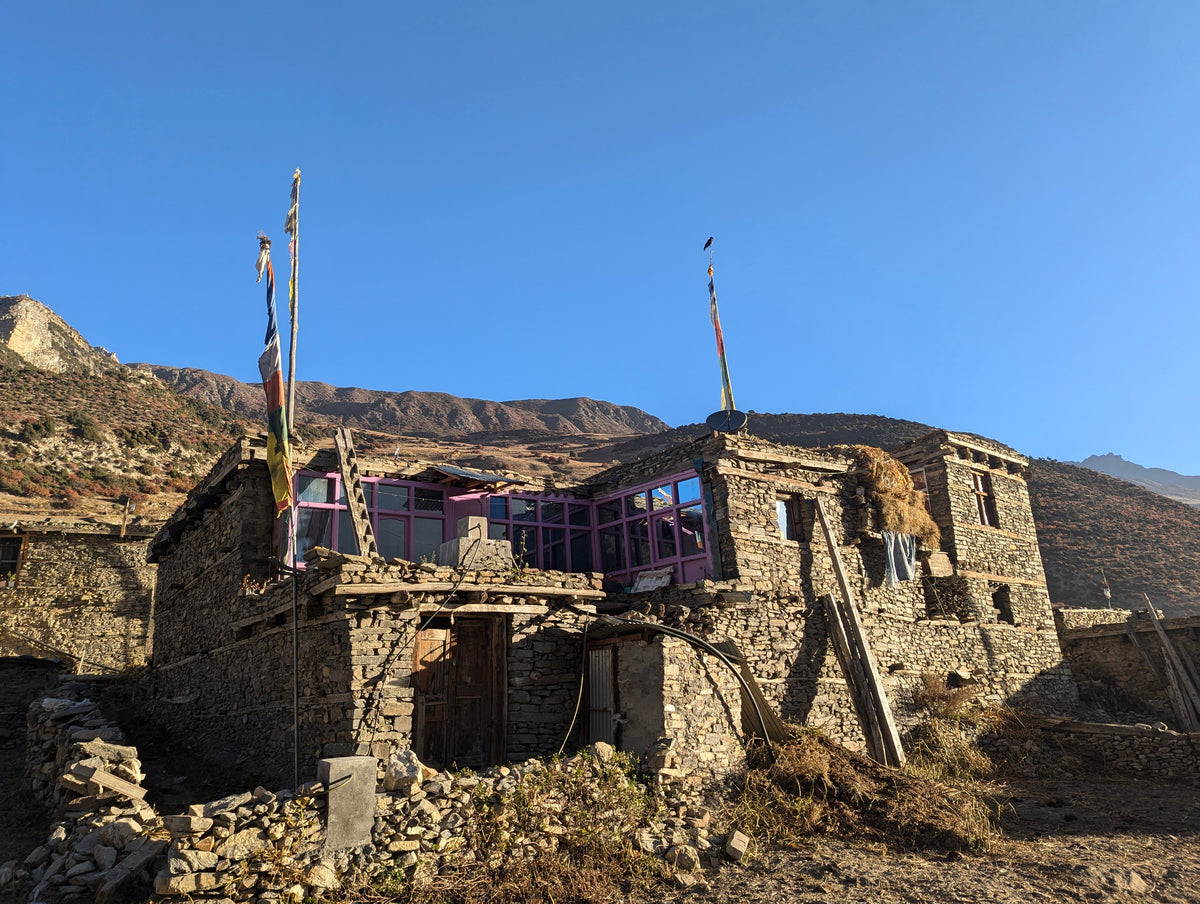
Old stone house in Manang, Nepal.
Mountain panorama from Bhraka in Manang, Nepal.
Old stone house in Manang, Nepal.
Welcome sign in Marpha, Mustang, Nepal.
Krishna Mandir and Garuda column in Patan, Nepal.
Pashupatinath temple roofs in Kathmandu, Nepal.
Boats and reflections on Phewa Lake, Pokhara, Nepal.
Annapurna Circuit Trek Nepal route map

23 Days, Challenging

23-Day Annapurna Circuit Trek Nepal

From $4,275 per person

  • Next departure Apr 8, 2027
  • Join a group of up to 10, or go private. Large groups welcome.
Duration
23 Days
Best season
Spring & Autumn
Max altitude
5,416m (17,769ft)
Difficulty
Challenging

Challenging: 5 to 8 hours of walking a day for two weeks or more, with nights up to about 5,200 m (17,000 ft) and a pass or viewpoint above 5,000 m (16,400 ft). Read your trip's walking demands, highest daytime and sleeping altitudes, terrain, technical requirements and gear list before booking.

We reply within one business day. No payment to ask.

Sherpa guides
Permits & logistics included
Private trips available
Altitude safety expertise
A US company, paid in dollars

The climb to Thorong La

From Besisahar at 820 m to Thorong La at 5,416 m (17,769 ft), the highest point of the trip.

Ask about this trip

A full circuit of the Annapurna massif: three weeks of walking through more cultures and landscapes than almost any other trek in Nepal.

The trek begins in subtropical farmland, climbs from the Hindu middle hills to the Buddhist high plateau, crosses one of the highest trekking passes in the world at 5,416 meters, and descends through the world’s deepest river gorge before ending with the sunrise view from Poon Hill. Few treks in Nepal cover this range of altitude, landscape, and culture in a single route, and you need no mountaineering skills to walk it.

From Besisahar the trail follows the Marsyangdi Valley upstream, and the country changes almost every day. The waterfalls and terraced rice fields of the lower valley give way to pine and juniper forest, then to the open, dry terrain of the high Manang plateau. The Annapurna range, including Lamjung Himal, is in view for most of the climb above the trail on the left, with the Manaslu range on the right. By Manang, at 3,500 meters, the landscape has gone from tropical to Tibetan, and so have the villages, the houses, and the people.

Thorong La, at 5,416 meters, is the high point of the circuit. You leave Thorong Phedi early, in the cold and dark, climb for about five hours on a wide, well-marked trail, and then make the long descent to Muktinath at 3,800 meters. From the pass you look across the northern arc of the Himalaya. Muktinath is one of the most important pilgrimage sites in Nepal, sacred to Hindus and Buddhists alike for a gas seep that burns above a spring, fire and water in the same place. Pilgrims have been walking here for over two thousand years.

On the way back down, the trail follows the Kali Gandaki gorge. The river runs between Dhaulagiri (8,167 meters) and Annapurna I (8,091 meters), and at its deepest the gorge measures around 5,500 meters from river to summit. The Thakali villages of Tukuche and Marpha have a building style of their own, with covered lanes and whitewashed walls built against the constant Kali Gandaki wind. The hot springs at Tatopani, the forests of Ghorepani, and the sunrise from Poon Hill finish the circuit.

The price covers five hotel nights in Kathmandu and Pokhara, 17 nights in mountain lodges and tea houses, and all meals on the trek. Sherpa guides, porter support, private ground transportation and Annapurna Conservation Area permits are included. Nepal entry visa fees are not included.

High-altitude travel can cause serious illness, even in fit travelers. Acclimatization reduces risk but cannot eliminate it. Tell your guide promptly about symptoms. Your guide may stop an ascent, change the route or arrange descent. Rescue and medical treatment depend on location, weather, access and available resources and cannot be guaranteed.

SherpaHolidays Terms and Conditions SH-TC-2026-10-14. Your accepted booking version and mandatory rights remain in effect.

23 Days Around the World’s Tenth-Highest Peak

Days 1 to 3  |  Kathmandu

Arrive in Kathmandu for the trek briefing and three days in the valley. The UNESCO World Heritage Sites of Swayambhunath, Pashupatinath, Boudhanath, and the Durbar Squares of Kathmandu and Patan are a good introduction to the Buddhist and Hindu traditions you will meet in the villages on the trek. We arrange your Annapurna Conservation Area and TIMS permits during these days.

Days 4 to 7  |  Into the Marsyangdi

Drive to Besisahar, or fly to Pokhara and drive on from there, and start trekking up the Marsyangdi Valley. The lower valley is lush and subtropical, with waterfalls on the hillsides, terraced farmland on both banks, and a green, fast river under the suspension bridges. You pass through Bahundanda, Chamje, and Dharapani as the gorge deepens, the valley walls steepen, and the peaks come into view.

Days 8 to 11  |  Manang and the High Plateau

Above Dharapani the trail enters the rain shadow of the Annapurna range. Subtropical forest gives way to pine, then juniper, then the open highland of the upper Marsyangdi. Chame, Pisang, and Braga are Buddhist villages, with gompas, prayer wheels, and flat-roofed stone houses in a Tibetan tradition preserved by the altitude and by the mountains that keep out the monsoon. Manang, at 3,500 meters, is the largest settlement in the upper valley and sits below the Gangapurna glacier. The acclimatization days here matter, because the pass is still 2,000 meters higher.

Days 12 to 14  |  Thorong La and Muktinath

Leave Thorong Phedi before dawn. At the slow pace the altitude demands, the climb to the pass at 5,416 meters takes five to six hours on a well-marked trail wide enough for trekkers moving in both directions. The col is windy and cold, with views across the northern arc of the Himalaya when the weather allows. The descent to Muktinath is long, and with an early start you reach the temple complex in the early afternoon, with time to visit the sacred spring and the gompas.

Days 15 to 19  |  The Kali Gandaki and Tatopani

Walk down the Kali Gandaki gorge, past Kagbeni and the Thakali villages of Marpha and Tukuche, whose covered stone lanes and whitewashed walls are built against the wind that blows up the gorge from the south every afternoon. The hot springs at Tatopani (1,190 meters) are welcome after two weeks of high-altitude walking, and travelers on the Kali Gandaki have soaked in them for centuries.

Days 20 to 23  |  Poon Hill and the Return

The last walking days climb from Tatopani through the rhododendron forests of Ghorepani to Poon Hill (3,210 meters), where the whole Annapurna range and Dhaulagiri catch the first light. Then descend through the Gurung villages of Tikhedhunga and Birethanti to Pokhara for two nights, before you fly or drive back to Kathmandu for your last day and departure.

Day by Day

Days 1 to 3  Kathmandu  The Cultural Foundation

The SherpaHolidays team meets you at Tribhuvan International Airport and takes you to the hotel. That evening’s briefing covers the full 23-day circuit: the altitude profile from Besisahar over Thorong La and down to Pokhara, the acclimatization plan for the Manang days, daily distances and terrain, how the lodges along the route work, and what the pass crossing asks of you. The circuit is well established and the lodges are reliable, but Thorong La, at 5,416 meters, needs proper preparation, and the briefing is there to get you to the pass in good shape.

The valley days are well worth the time. Swayambhunath, on its hilltop above the city, has been a center of Buddhist practice for over two thousand years, and its stupa can be seen from across the valley. Pashupatinath, on the Bagmati River, is the most sacred Hindu site in Nepal; with its cremation ghats, sadhus in ochre robes, and constant activity, it is a place to visit slowly. The medieval Durbar Squares of Kathmandu and Patan are full of Newari stone carving and timber architecture. Boudhanath, the great stupa east of the city, is the center of Kathmandu’s Tibetan Buddhist community and one of the largest stupas in the world. We arrange your Annapurna Conservation Area permit and TIMS trekking permit during these three days.

Stay: Luxury Hotel in Kathmandu

Days 4 to 7  Besisahar to Dharapani  The Marsyangdi Valley

You reach Besisahar (820 meters) by road from Kathmandu, or by a short flight to Pokhara and a drive north, with the Annapurna range above the foothills as you get close. Besisahar is a busy market town at the mouth of the Marsyangdi valley, and the trail starts at the edge of town, drops to the river, and follows it upstream. The lower Marsyangdi is a deep gorge in places and wide farmland in others; the trail crosses the river on suspension bridges and climbs the valley walls where the gorge is too narrow to follow the river.

This subtropical start is one of the things that sets the circuit apart. In the monsoon and post-monsoon months waterfalls drop from the walls above the trail, the vegetation is thick, and Bahundanda and Chamje are Hindu villages of the middle hills, with terraced rice and millet fields and Hindu temples. All of this changes within a few days, and the difference between the lower valley and Manang is a big part of what makes the circuit worth walking. After several days the trail reaches Dharapani (1,960 meters), where the Dudh Khola joins the Marsyangdi and the valley opens out.

Stay: Best Available Mountain Lodges

Days 8 to 11  Chame to Manang  The High Plateau

Above Dharapani the trail climbs deeper into Manang district and the landscape starts to turn from subtropical to Tibetan. The forest changes first: pine replaces rhododendron, the trees thin out, and the light gets harder. Chame (2,670 meters) is the administrative center of upper Manang, with government offices and small shops, the last town of its kind before the more remote villages above. Past Chame the valley opens: Annapurna II and Annapurna IV rise on the left, the cliffs on the right bank are sheer and huge, and in the dry season the river runs green and clear.

Pisang (3,300 meters) comes in two parts: upper Pisang on the ridge, with its gompa and views north toward the dry plateau, and lower Pisang in the valley, where most trekking groups stay. The upper village is worth the extra climb for its old gompa and for views you do not get from the lower trail. Braga, between Pisang and Manang, has one of the oldest gompas in the Annapurna region; its murals and statues have survived because the altitude and the rain shadow spare them the damp that ruins similar work in the lower valleys.

Manang (3,500 meters) is a sizable village for the high plateau, its flat-roofed stone houses below the hanging glacier of Gangapurna on the northern wall. The acclimatization days here are active rather than restful: a walk up to the viewpoint above Manang at 3,800 meters, farther to Gangapurna lake at 3,900 meters, or up toward Ice Lake at 4,600 meters if you want a harder altitude day. The Himalayan Rescue Association runs a health post in Manang during the trekking season, and its altitude talks are useful before the pass.

Stay: Best Available Mountain Lodges

Days 12 to 14  Thorong La to Muktinath  The Great Crossing

The walk from Manang to Thorong Phedi (4,450 meters) takes most of a day up the upper Marsyangdi valley, climbing steadily into bare ground where nothing grows above 4,000 meters. Thorong Phedi is a group of lodges in a cold, windy hollow at the foot of the pass, and most groups sleep here rather than going on to the tea house at 4,900 meters. Sleep is hard at this altitude, but even a cold, broken night is better than none before the predawn start.

You start the climb to Thorong La in the dark, by headlamp, with the temperature well below freezing. The path is steep at first, then eases into a long slope of switchbacks below the col. As you reach the upper section, the sun catches Yakawa Kang and Khatungkang above you while the trail below is still in shadow. You reach the col, at 5,416 meters, after five to six hours of walking, with views north across the Tibetan-style country of upper Mustang and south toward the Dhaulagiri range, and a steady, cold wind. The descent on the far side is long: 1,600 meters down to Muktinath over gray and brown scree, with the wide Kali Gandaki valley opening below.

With a predawn start from Thorong Phedi, you reach Muktinath (3,800 meters) in the early afternoon. The temple complex is sacred to both Hindus and Buddhists because of a natural gas seep that burns above a spring, fire and water in the same place. Hindu pilgrims who have come up from the southern plains bathe under the 108 water spouts around the temple, and Buddhists worship at the gompa above the spring. Both communities come on the same days, and nobody arranges it; the site has always been shared this way.

Stay: Best Available Mountain Lodges

Days 15 to 19  Kagbeni to Tatopani  The Deepest Gorge

The trail south from Muktinath descends through Kagbeni, the gateway to upper Mustang, where the medieval fort and the checkpoint for the restricted area are visible from the trail. The Kali Gandaki gorge proper starts at Kagbeni. In the afternoon, the wind funnels up the valley from the south hard enough to slow you down if you set out late. Below Kagbeni, the Thakali village of Marpha has some of the most distinctive architecture on the circuit: covered stone lanes built against the wind, whitewashed walls, apple orchards on the slopes above, and the apple brandy the village has made for generations.

Farther down, Tukuche and Ghasa are built in the same Thakali style. The gorge is deepest where the valley passes between Dhaulagiri to the west and Annapurna I to the east. Measured from river to summit, this is the deepest river gorge in the world: Dhaulagiri (8,167 meters) and Annapurna I (8,091 meters) rise within 35 kilometers of each other on either side of the same valley. The rock here was once the floor of the Tethys Sea, and ammonite fossils turn up in the riverbed and the cliffs around it.

Tatopani (1,190 meters) is known for its hot springs, natural pools at the river’s edge fed by geothermal water. After two weeks of walking above 3,000 meters, an hour in the pools does more for tired legs than any lodge shower. Tatopani is subtropical again, with banana trees, ferns, and warm, humid air that returns suddenly after the cold, dry plateau. Going from one to the other in a single trek is one of the things that sets the circuit apart.

Stay: Best Available Mountain Lodges

Days 20 to 23  Ghorepani to Kathmandu  Poon Hill and the Return

The climb from Tatopani to Ghorepani gains about 1,700 meters through rhododendron forest, in full bloom in March and April and thick with moss after the monsoon. Ghorepani (2,874 meters) is the base for the Poon Hill sunrise, and its lodges fill with trekkers from both the circuit and the shorter Poon Hill loop from Pokhara. The walk up to Poon Hill (3,210 meters) takes thirty minutes in the dark and gets you there for first light on the Annapurna range. From the top you see the whole southern face of the Annapurna massif, from Dhaulagiri in the west through the Annapurna I summit, Annapurna South, Hiunchuli, and Machapuchare to Lamjung Himal in the east. In the minutes around sunrise, the faces are full of the color and shadow that the flat midday light takes away.

The descent from Ghorepani through Tikhedhunga and Birethanti to Nayapul passes through the Gurung villages of the Annapurna foothills, with their terraced fields and stone houses. From Nayapul it is an hour’s drive to Pokhara, where two unhurried nights on the shore of Phewa Lake end the trek. Then fly or drive back to Kathmandu for a last day in the city, for shopping in Thamel or one more visit to the valley temples, before your international departure.

Stay: Best Available Mountain Lodges then Luxury Hotel in Pokhara then Luxury Hotel in Kathmandu

The Sherpa Standard

Every SherpaHolidays trip is fully supported from arrival to departure. Here is what that means on this one.

Accommodation and Meals

  • City Hotels: 5 nights in boutique hotels in Kathmandu and Pokhara.
  • Mountain Lodges: 17 nights in mountain lodges and tea houses along the circuit, chosen for comfort, cleanliness, and location.
  • Full Board on Trek: Nutritious meals throughout the 23-day trip, with breakfast, lunch, and dinner at every lodge.

Leadership and Support

  • Expedition Guide: A dedicated English-speaking Sherpa lead guide who knows the Annapurna Circuit, Himalayan culture, and high-altitude terrain well.
  • Sherpa Support Team: Professional porters and assistants who handle all logistics and your personal luggage.
  • Safety Protocol: Careful management of the Thorong La crossing and daily health checks throughout the high-altitude section.

Transport and Permits

  • Approach Options: Your choice of a flight to Pokhara past the Manaslu range or a private coach along the Prithvi Highway through the foothills.
  • Private Transfers: All ground transportation in a comfortable private vehicle.
  • Permits: All Annapurna Conservation Area permits and local government taxes, fully covered.


What Is Not Included

  • International airfare to and from Kathmandu and Nepal entry visa fees
  • Lunch and dinner in Kathmandu
  • Technical trekking clothing, specialized boots, and personal medications
  • Comprehensive travel insurance, which is a condition of every booking. Your policy must cover emergency medical treatment, emergency evacuation, trip cancellation and interruption, and repatriation. We can recommend providers.
  • Tips for guides and porters
  • Single supplement (for those taking a private room)

Five Highlights

Thorong La: One of the Highest Trekking Passes in the World

Everything on the circuit builds toward the crossing of Thorong La at 5,416 meters. You climb in the dark, the sun reaches the peaks above the col, the view from the top runs across the northern arc of the Himalaya, and then comes the long descent to Muktinath. Ask people who have walked the circuit what they remember most, and it is usually this day. The pass is well marked and well used, but the altitude is real, and the acclimatization days at Manang are there because it cannot be rushed. Reaching the col in good shape is the result of three weeks of careful altitude gain.

The Kali Gandaki: The World’s Deepest Gorge

The Kali Gandaki flows between Dhaulagiri and Annapurna, and measured from river to summit, its gorge is deeper than any other river gorge in the world. The trail runs through the Thakali villages of Marpha and Tukuche, with covered stone lanes, whitewashed walls, and apple orchards, one of the most distinct building traditions in Nepal. The ammonite fossils in the riverbed are left from the Tethys Sea, which covered this ground before the Himalaya rose. The afternoon wind that funnels up the gorge is strong enough to make walking hard, and it has shaped this valley and its villages for far longer than there have been trekking trails.

Muktinath: Where Fire Meets Water

Muktinath, at 3,800 meters, has drawn Hindu and Buddhist pilgrims for over two thousand years. Both traditions see the divine in the same natural feature: a gas seep that burns above a spring, fire and water in one place. Hindu pilgrims from across South Asia bathe under the 108 water spouts around the temple, and Buddhists worship at the gompa above the spring. On a busy pilgrimage day both communities are there together, as they have been for as long as either has been in the Himalaya.

Sunrise at Poon Hill

The walk from Ghorepani up to Poon Hill (3,210 meters) takes thirty minutes in the dark. The top is a broad platform looking across the whole southern face of the Annapurna massif, from Dhaulagiri in the west to Lamjung Himal in the east. Around sunrise, before the daylight flattens them, the peaks are full of color and shadow. Machapuchare, the unclimbed sacred peak whose double summit gives it the local name Fishtail, sits in the center of the view. It is the photo most people bring home from the circuit.

The Communities of the Circuit

Few trekking routes in Nepal pass through as many distinct communities. The Hindu villages of the lower Marsyangdi give way to Gurung settlements in the middle hills, then to the Buddhist Manangi villages of the high plateau, whose old trade links with Lhasa still show in the gompas, the prayer flags, and the flat-roofed houses. The Thakali of the Kali Gandaki are a fourth tradition: merchants whose control of the salt trade between Tibet and the lower valleys paid for the covered-lane villages you walk through at Marpha and Tukuche. You meet all of them in three weeks, which is one of the best reasons to walk the full circuit.

Travel dates

The deposit is part of the total price, not an additional fee.

  • April 8 – 30, 2027 Available
    $4,275 per person
  • October 8 – 30, 2027 Available
    $4,275 per person
  • November 3 – 25, 2027 Available
    $4,275 per person

Scheduled departure deposit: $500 per person for bookings more than 90 days before departure

Private journey deposit: 30% of the trip price for bookings more than 90 days before departure

Final balance: Due 90 days before departure. Bookings made 90 days or fewer before departure are paid in full at booking.

Our conditions promise: A qualifying Nepal advisory change or trek-region closure within 60 days of departure lets you move dates free or take full credit for 24 months.

Scheduled departures: No minimum group size

SherpaHolidays Terms and Conditions SH-TC-2026-10-14. Your accepted booking version and mandatory rights remain in effect.

Questions about this trip?

Ask Sam or Gyalgin

We reply within one business day. No payment, no commitment.

Loading the inquiry form…

This is an inquiry, not a booking. Nothing is charged here.

  • Within one business day We reply within one business day.
  • Then A call, if you would like one.
  • When you are ready A deposit holds your place.

Or talk to us directly:

+1 (855) 743-7725 info@sherpaholidays.com

Things guests ask before booking

Straight answers about booking, payment and how we run every trip.

  • It is the hardest day of the trek. You leave Thorong Phedi before dawn, and at the slow pace the altitude calls for, the climb to the pass at 5,416 meters (17,769 ft) takes five to six hours on a well-marked trail. The top is windy and cold. The descent to Muktinath is long, and with the early start you get there in the early afternoon.

  • Before the pass you spend acclimatization days in Manang, at 3,500 meters, which is still 2,000 meters below the Thorong La. Your guide runs daily health checks through the high section and manages the pass crossing with care.

    High-altitude travel can cause serious illness, even in fit travelers. Acclimatization reduces risk but cannot eliminate it. Tell your guide promptly about symptoms. Your guide may stop an ascent, change the route or arrange descent. Rescue and medical treatment depend on location, weather, access and available resources and cannot be guaranteed.

  • In boutique hotels in Kathmandu and Pokhara, and in mountain lodges and tea houses along the circuit. Breakfast, lunch and dinner at every lodge are included. In Kathmandu, lunch and dinner are on your own. Porters carry your personal luggage.

  • Yes. After the Kali Gandaki and the hot springs at Tatopani, the last walking days climb through the rhododendron forest of Ghorepani to Poon Hill (3,210 meters) for the sunrise over the Annapurna range and Dhaulagiri. Then you walk down to Pokhara for two nights.

  • Your own trekking clothing, boots and any personal medications. These are not included. Your guide goes over gear at the trek briefing in Kathmandu.

  • Groups of up to 10, or private for your own group. Scheduled group dates have no minimum, so they run with any number of guests. Large groups welcome.

  • The deposit is part of the total price, not an additional fee. A scheduled booking made more than 90 days before departure requires $500 per person. A private journey booked more than 90 days before departure requires 30% of the trip price. The balance is due 90 days before departure. At 90 days or fewer, full payment is due at booking. Your disclosure and invoice state the exact amounts and dates.

    Once your deposit is received, your price is locked except for government taxes, park fees or levies introduced after that date. We tell you in writing as soon as we learn of one and identify its amount and basis. A different route, hotel upgrade or optional activity is not an automatic extra charge; any additional cost requires your agreement before it is booked.

    SherpaHolidays Terms and Conditions SH-TC-2026-10-14. Your accepted booking version and mandatory rights remain in effect.

  • Scheduled departure deposit
    $500 per person for bookings more than 90 days before departure

    Private journey deposit
    30% of the trip price for bookings more than 90 days before departure

    Final balance
    Due 90 days before departure. Bookings made 90 days or fewer before departure are paid in full at booking.

    You cancel 90 or more days before departure
    Your deposit becomes credit toward any SherpaHolidays trip for 24 months. Payments above the deposit are refunded, subject only to a specific supplier exception disclosed and accepted before payment.

    You cancel 89 to 60 days before departure
    Cancellation charge: 50% of the total trip price

    You cancel 59 to 46 days before departure
    Cancellation charge: 75% of the total trip price

    You cancel 45 days or fewer before departure
    Cancellation charge: 100% of the total trip price. No refund.

    Our conditions promise
    A qualifying Nepal advisory change or trek-region closure within 60 days of departure lets you move dates free or take full credit for 24 months.

    We cancel or cannot provide contracted services
    Refunds for services not provided as required by California law. An alternative or credit is your choice, not a required substitute.

    Scheduled departures
    No minimum group size

    The traveler-cancellation table does not remove our conditions promise, rights under an already accepted booking, or refunds and other rights required by law.

    If the US State Department raises Nepal to Level 3 or higher, or your trek region is closed, within 60 days of departure, you can move your dates free or take full credit toward any SherpaHolidays trip for 24 months. This applies instead of the normal traveler-cancellation charges, including the 45-day rule and any supplier cancellation exception.

    Full credit means the payments you made for the affected trip, not only the deposit. We record the trigger and your choice in writing. The credit follows Section 4's use and validity terms. A free date move has no change fee; we disclose any price difference for the replacement trip before you decide. The promise does not replace a cash refund owed when we cancel or cannot provide contracted services.

    SherpaHolidays Terms and Conditions SH-TC-2026-10-14. Your accepted booking version and mandatory rights remain in effect.

  • Comprehensive travel insurance is a condition of every booking. Your policy must cover emergency medical treatment, emergency evacuation, trip cancellation and interruption, and repatriation. Confirm with your insurer that it covers your itinerary's activities and maximum altitude, including technical climbing, rafting, helicopter evacuation and search and rescue where applicable. Provide proof before departure. Consider obtaining cover when you book because some benefits have purchase deadlines.

    We are not your insurer. Receiving your documents is not a determination of coverage and does not guarantee payment of a claim. Medical and evacuation providers may require payment in advance. Keep insurer emergency details available during your trip.

    SherpaHolidays Terms and Conditions SH-TC-2026-10-14. Your accepted booking version and mandatory rights remain in effect.

  • Yes. Any departure can run privately on your dates, and we adjust pace, accommodation and rest days around you. If you want a different route entirely, we plan custom itineraries from scratch.

  • Guides from our own Sherpa team lead every trip in Nepal. Beyond Nepal we work with trusted local partners we have known for years, so there is always someone beside you who knows the ground well.

  • The Sherpa Standard section on this page lists everything included on this trip, from guides and permits to lodges and meals. International flights and travel insurance are the main things you arrange yourself.

Guest reviews

What guests say

5.0 average from 5 Google reviews
Read them on Google
I recently took a trip to Nepal and was met with wonderful service by the staff and amazing tours with the Sherpa guides. The cultural tours were by far my favorite. Highly recommend!!
Avin Fatehi
Took a trip to Nepal for 10 days and got an amazing tour of the area! Great people, great places 10/10 would go again 🔥🔥
Kevin Ye
I found Sherpa Holidays when I was looking to do the 23 days Annapurna circuit trek and they not only made me a custom itinerary to fit my needs, but they also made the entire process seamless. Highly recommend Sherpa Holidays for anyone looking to head to Nepal!
Justin Zhang
The staff were easy to communicate with and I had a wonderful trip.
Jack Cavada

Reviews shown as published on our Google profile.